
Welding · Lithuania
Robotic, laser and manual welding
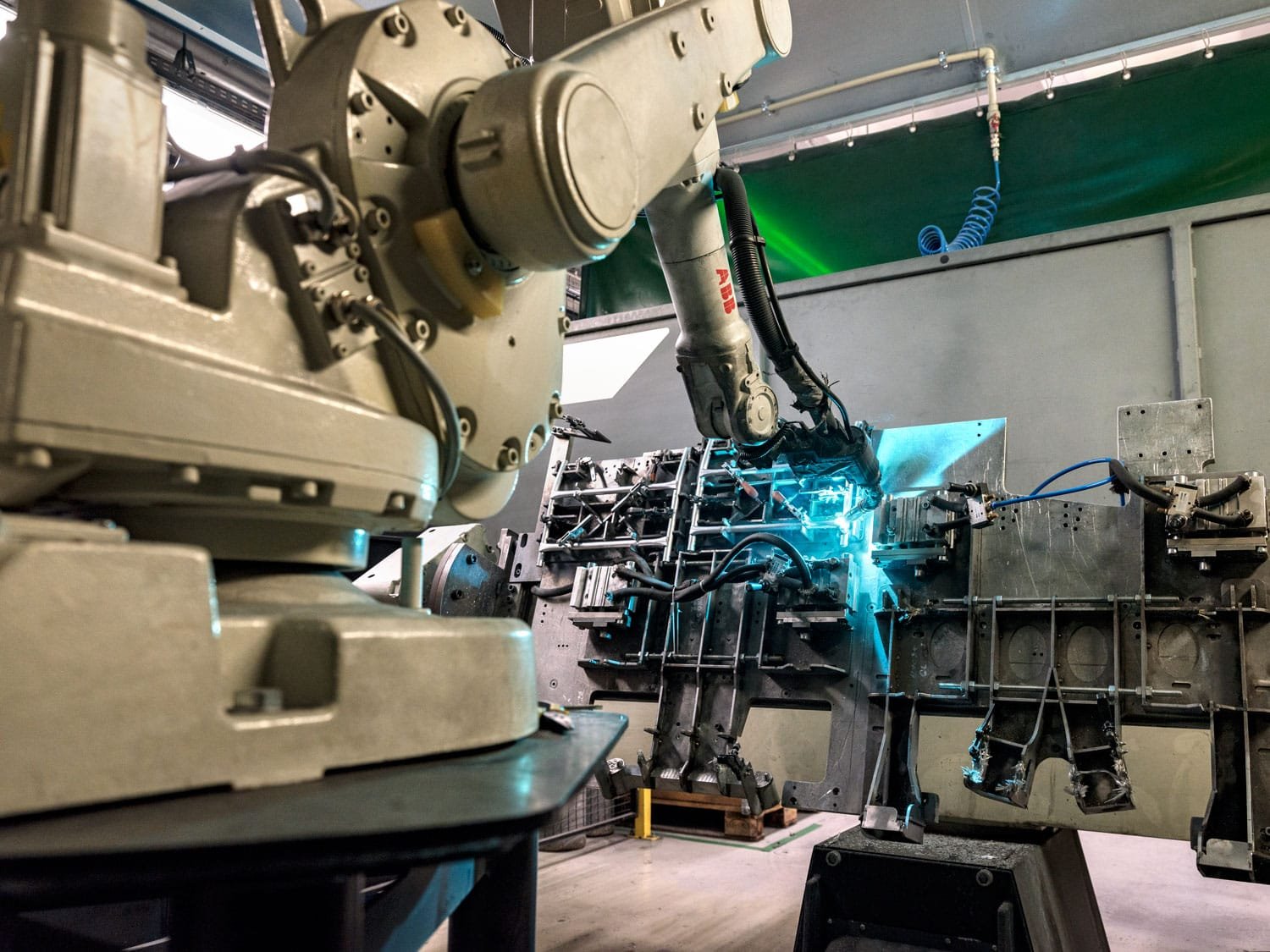
Aluminium, carbon steel and stainless steel welding in one plant: ABB robot with Fronius CMT for series, laser welding for thin and visible joints, TIG and MIG/MAG for prototypes and one-offs. Welds repeat from the first part to the last.
- ABB + Fronius CMTrobotic welding for series
- Lasernarrow seam, low heat input
- TIG · MIG/MAGone-offs and prototypes
- 3 metalsaluminium, steel, stainless
Welding at Alumnita – key facts
UAB Alumnita provides robotic (ABB + Fronius CMT), laser and manual TIG and MIG/MAG welding of aluminium, carbon steel and stainless steel – from prototypes to series, with coating and assembly in the same plant.
- Robot
- ABB with Fronius CMT
- Processes
- CMT, laser, TIG, MIG/MAG
- Quality
- ISO 3834-2 requirements being implemented
Welding as part of the process chain, not a separate service
In many subcontracting projects welding is where time and accuracy are lost: parts come from another supplier, do not fit the fixture, distort and return for straightening. We weld parts we have laser cut ourselves in the same plant, so tolerances, edge quality and fixtures are matched from the start.
We choose the process for the joint, not for whichever machine is free: robotic CMT for aluminium series, laser for thin and visible joints, TIG for demanding one-off welds. Welded assemblies go straight to chemical pre-treatment and powder coating.
Which welding process to choose
| Process | Best for | Materials | Benefits | Batch size |
|---|---|---|---|---|
| Robotic CMT (ABB + Fronius) | repeating welds, frames, enclosures, brackets | aluminium, steel, stainless | consistent welds, little spatter, low distortion, stable cycle time | from tens of pieces to series |
| Laser welding | thin sheet, visible seams, tight joints | stainless, steel, aluminium | narrow clean seam, small heat-affected zone, less grinding | from prototype |
| TIG | high-quality single welds, thin profiles, tubes | aluminium, stainless | precise control, neat seam | 1–50 pcs |
| MIG/MAG manual | heavier structures, non-standard assemblies | steel, aluminium | productivity, flexibility | 1–100 pcs |
Robotic CMT welding: repeatability in series
The ABB robot with a Fronius CMT (Cold Metal Transfer) power source welds to a program, so weld length, position and profile repeat on every part. In CMT the wire moves forward and back and the arc is interrupted during droplet transfer – less heat goes into the part than in conventional MIG.
- Thin aluminium sheet welded without burn-through and with minimal distortion
- Almost no spatter – less grinding before coating
- Fixtures designed together with the part – gaps and positions controlled
- Stable cycle time for accurate planning and pricing
- Programs are stored – repeat orders start without new set-up
Laser welding: narrow seam, low heat input
Laser welding suits joints that are visible or where distortion is not acceptable: stainless enclosures, covers, thin sheet products and tight joints. The seam is narrow and smooth, the heat-affected zone small, so parts shrink less and finishing is often limited to light cleaning.
What makes aluminium welding different
Aluminium conducts heat about three times better than steel, carries a tough oxide layer and melts at a low temperature. Thin sheet distorts easily and poorly prepared surfaces cause porosity. We control these risks through the process:
- Surface preparation before welding – removal of grease and oxide
- Filler wire matched to the alloy (e.g. AlSi5 / AlMg5 types for 6xxx and 5xxx alloys)
- Low-heat CMT process and a weld sequence that limits distortion
- Fixtures that hold geometry while cooling
- Visual weld inspection and dimensional check after welding
Designing parts that are easy and cheap to weld
- Use tab-and-slot features – laser-cut parts locate themselves, fixtures become simpler
- Avoid welds in hard-to-reach places – robot and welder need access
- Symmetrical weld placement reduces distortion
- Specify only the welds you need – a continuous weld is not always stronger than a stitch weld
- Mark visible and functional welds and the required finish on the drawing
- If the part is coated, add drain and hanging holes
What determines welding cost
Send a drawing and your annual volume – we will compare robotic and manual options and quote with all operations included.
- Number and total length of welds
- Process: robotic CMT makes series cheaper, manual TIG costs more per metre
- Need for and complexity of fixtures (a one-off investment for series)
- Material and thickness
- Required weld finish and inspection level
- Batch size and repeat frequency per year
FAQ
Frequently asked questions
From what quantity does robotic welding pay off?
It depends on the number of welds and part complexity. A robot usually pays off when the part repeats – even batches of a few dozen if the order is recurring.
When should I choose laser welding?
When parts are thin, seams are visible or distortion is not acceptable.
Do you weld one-offs and prototypes?
Yes, with TIG and MIG/MAG. Once approved, the part moves to robotic production.
Which materials do you weld?
Aluminium (5xxx and 6xxx alloys), carbon steel and stainless steel.
Can you coat welded assemblies?
Yes, they go to automatic chemical pre-treatment and the powder coating line in the same plant.
How do you control weld quality?
Visual inspection of welds and dimensional checks to the drawing. We are implementing ISO 3834-2 welding quality requirements.
What is CMT?
Cold Metal Transfer – a low-heat MIG variant in which the wire moves back and forth and the arc is interrupted during droplet transfer, reducing distortion and spatter.
Do you build welding fixtures?
Yes, fixtures for series production are designed and made together with the part.
Do you weld stainless steel?
Yes, by TIG, laser and robotic welding.
Robotic, laser and manual welding in Lithuania
Metal welding joins parts by melting the edges, with filler material where needed, to create a continuous load-bearing seam. In our plant in Kaunas, Alumnita uses four processes: robotic CMT welding (ABB robot with a Fronius CMT power source), laser welding, TIG and MIG/MAG. The process is selected by material, seam visibility, distortion requirements and batch size.
Robotic CMT welding delivers uniform seams, low spatter and a constant cycle time for repeat frames, enclosures and brackets. Laser welding suits thin sheet and visible seams – the narrow seam and minimal heat-affected zone reduce grinding. TIG and MIG/MAG are used for prototypes, complex assemblies and heavier structures. We weld aluminium (6060, 6063, 6082, 5754, 5083), mild steel and stainless steel.
Because parts are laser cut in the same plant, gaps and geometry are controlled from the first operation, and welded products move directly to chemical pre-treatment and powder coating. ISO 3834-2 welding quality requirements are being implemented.
- Processes
- robotic CMT, laser, TIG, MIG/MAG
- Robot
- ABB with Fronius CMT power source
- Materials
- aluminium, mild steel, stainless steel
- Inspection
- visual seam inspection, dimensions to drawing
Submit your drawing – we deliver the finished product
Single-source manufacturing. The complete process chain – laser cutting, forming, robotic welding, powder coating and assembly – runs in our own plant in Kaunas, Lithuania. One supplier, one delivery date, one point of accountability.