
Stamping and forming
Aluminium and steel stamping
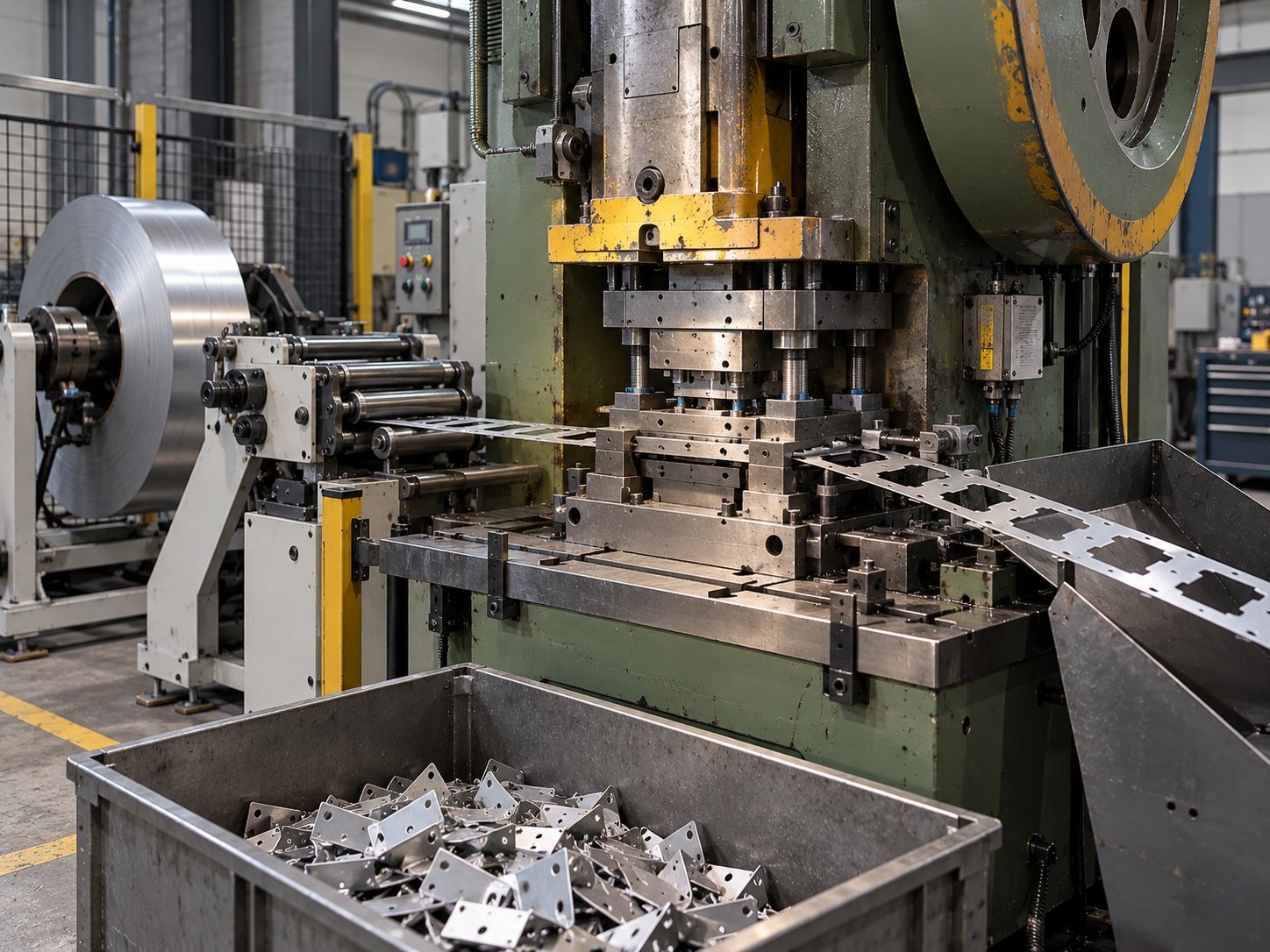
Stamping and forming of series parts on a fleet of 13 presses: twelve 6–25 t presses and one 40 t press. Dedicated quick-change dies make large batches efficient and changeovers fast.
- 13 presses6–25 t and 40 t
- Quick changedie system
- Al · steelstamping and forming
- For serieslowest unit cost
Stamping – the key facts
Alumnita stamps and forms serial parts in aluminium and steel on a fleet of 13 presses: 12 presses from 6 to 25 t and one 40 t press. We work with quick-change dies.
- Presses
- 12 × 6–25 t, 1 × 40 t
- Operations
- blanking, piercing, bending, forming
Press fleet
| Equipment | Capability |
|---|---|
| Mechanical presses | 12 units, 6–25 t (Dutch manufacturers) |
| High-tonnage press | 1 unit, 40 t |
| Operations | blanking, piercing, bending, forming, embossing |
| Materials | aluminium, mild steel |
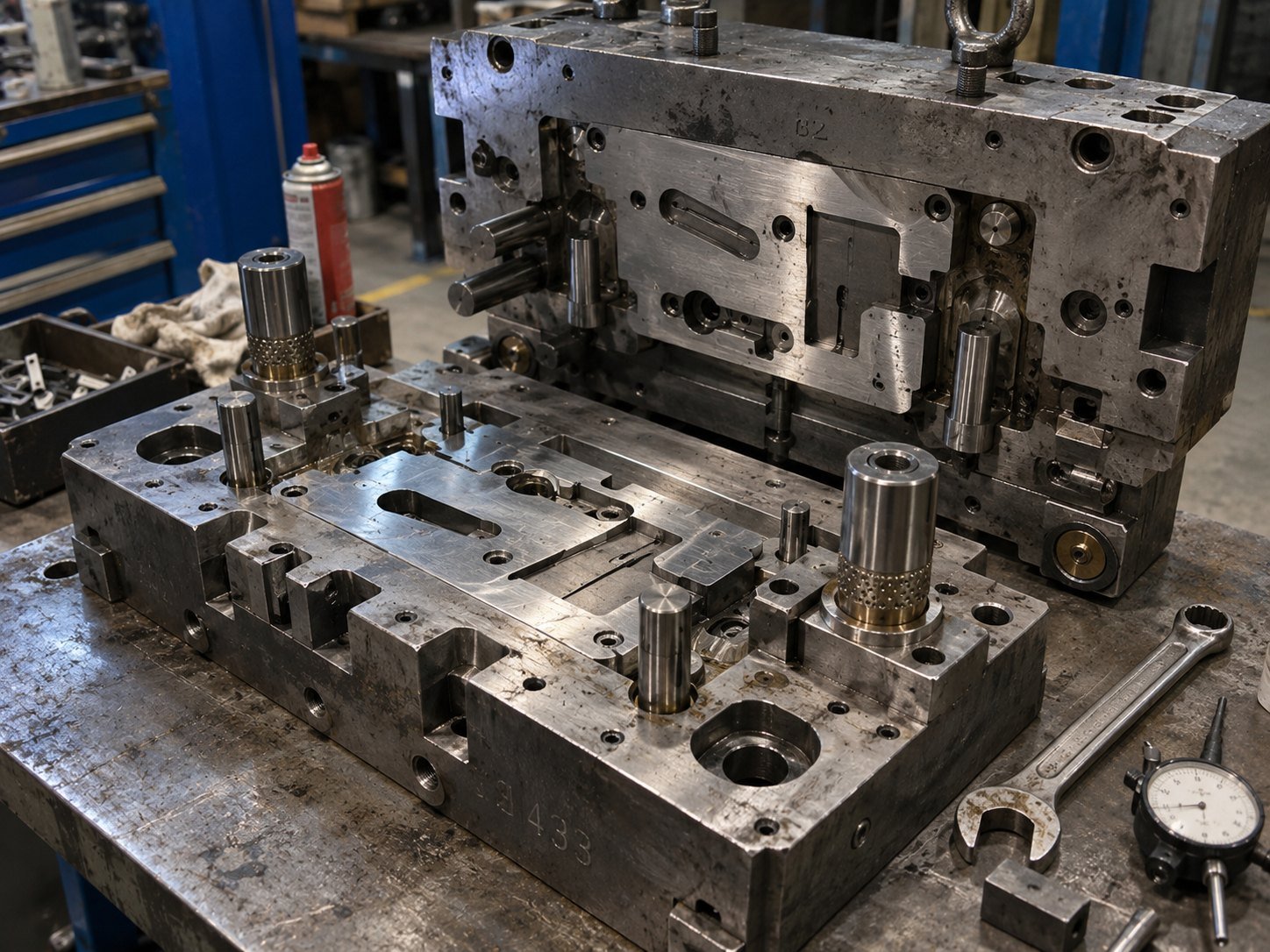
| Dies | custom, quick-change; produced through a long-standing partner |
| Break-even quantity | stamping usually pays off from 2,000–5,000 pcs per year |
What part size can be stamped
The limit in stamping is set not by the size of the press but by the cutting force. It equals the cut perimeter multiplied by material thickness and by the shear strength of that material. Below is the indicative maximum cut perimeter for our presses, with a reserve left for stripping force.
| Material and thickness | 6 t press | 25 t press | 40 t press |
|---|---|---|---|
| Aluminium 1 mm | ~300 mm | ~1,250 mm | ~2,000 mm |
| Aluminium 2 mm | ~150 mm | ~620 mm | ~1,000 mm |
| Aluminium 3 mm | – | ~410 mm | ~660 mm |
| Mild steel 1 mm | ~180 mm | ~750 mm | ~1,200 mm |
| Mild steel 2 mm | – | ~370 mm | ~600 mm |
How to read the table. “Cut perimeter” is the entire perimeter cut in a single stroke: the outer contour of the part plus the perimeters of all holes pierced at the same time. A 100 × 150 mm rectangle with four Ø10 mm holes gives 500 mm of outer contour and about 126 mm of hole perimeter – roughly 626 mm in total. Calculated with the usual shear strength of aluminium and structural steel; for harder alloys the limit is lower. If the part does not fit into one stroke, the operations are split across several stations or combined with laser cutting.
The table is for first orientation – whether your part fits our press fleet in principle. The binding answer comes from an engineer reviewing your drawing, taking the alloy, the forming operations and the die design into account.
Stamping or laser cutting?
We often use both: the prototype and first batches are laser cut, and once the part is approved and volumes grow, it moves to stamping.
| Criterion | Laser cutting | Stamping |
|---|---|---|
| Batch size | from 1 pc to medium series | large, recurring series |
| Tooling cost | none | die required |
| Unit cost | constant | falls as volume grows |
| Changes | edit the program | modify the die |
| Forming | no | yes – embossing, bends, shapes |
Why stamping in series
- Lowest part cost in large series
- Very short cycle time – seconds per part
- Excellent repeatability – all parts identical
- Blanking, piercing and forming possible in one stroke
- Quick-change dies – less downtime between products
After stamping – in the same workshop
- Stampingblanking, piercing, forming
- Welding or rivetingjoining the assemblies
- Pre-treatment and coatingchemical cleaning and powder coating
- Assembly and packingfinished product
FAQ
Frequently asked questions
From what quantity does stamping pay off?
Usually from 2,000–5,000 pcs per year. The exact threshold depends on part complexity and die cost: for a simple blanking and piercing die it is closer to 2,000 pcs, for a complex forming die closer to 5,000 pcs or more. For smaller quantities laser cutting is normally cheaper. Send us the drawing and your annual demand – we will compare both options with numbers.
Can you use our dies?
Yes, if they fit our presses. Dies are assessed before production starts.
Which materials do you stamp?
Aluminium and mild steel.
What part sizes can you stamp?
The limit is set not by the press but by the cutting force: it equals the cut perimeter multiplied by material thickness and shear strength. Indicative limits for our presses are in the table above. Your specific part is assessed by an engineer from the drawing – send it to us and we will tell you whether it fits our press fleet.
How long does die manufacturing take?
The lead time is agreed by our partner according to die complexity; we state it together with the price in the quotation, before work begins. Die manufacturing is a one-off – repeat orders with the same die start without additional preparation.
Do you make the dies yourselves?
We produce dies through a partner – long-established die makers we work with continuously. You deal with us only: we agree the die design, price, lead time and manufacturing, and then run that same die on our own presses. This avoids the situation where the die is built in one place, the parts are stamped in another, and nobody is accountable for the result.
Is stamping suitable for small batches?
Up to roughly 2,000 pcs per year laser cutting is almost always cheaper – no die investment is required. The exception is parts with embossings, stiffening ribs or three-dimensional shapes: these cannot be made with a laser, so a die is needed even for smaller quantities.
Metal stamping for series production
Metal stamping cuts, punches, bends and forms sheet metal in a press with a dedicated die, producing a part in one or several press strokes. Alumnita operates 12 mechanical presses from 6 to 25 t and one 40 t press, processing aluminium and mild steel.
Stamping gives the lowest unit cost in large repeat batches and creates embossing, stiffening ribs and shapes that laser cutting alone cannot. Prototypes and first batches are usually laser cut; as volumes grow, production moves to stamping – the technology is chosen by annual demand and die cost. Customer dies can be used if they fit our presses.
This service is one step in the wider sheet metal fabrication chain: cutting, forming, welding, coating and assembly all run in the same plant in Lithuania.
- Presses
- 12 × 6–25 t, 1 × 40 t
- Operations
- shearing, punching, bending, forming
- Materials
- aluminium, mild steel
- Dies
- custom-made or customer-supplied
Manufacturing to your drawing – we deliver the finished product
Single-source manufacturing. The complete process chain – laser cutting, forming, robotic welding, powder coating and assembly – runs in our own plant in Lithuania. One supplier, one delivery date, one point of accountability.