
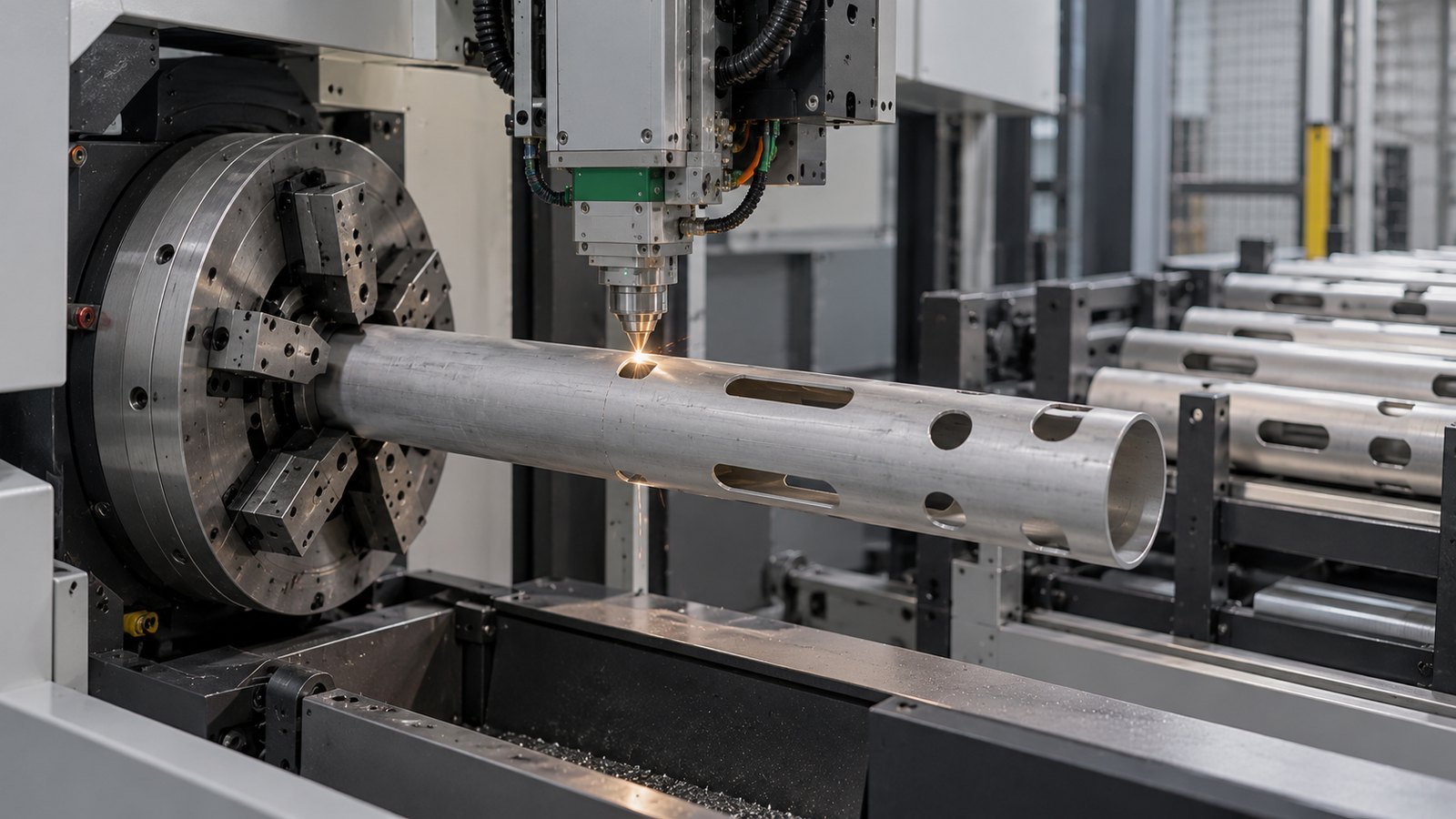
A tube laser replaces five separate operations – cutting to length, marking, drilling, coping the joints and preparing the weld gap – with one cycle, and in doing so removes the need for a welding jig. The real saving is not cutting speed; it is the intermediate operations that disappear and the fixture you never have to build.
What the machine does in one load
- Cut to length, including mitre and bevel cuts at the tube end.
- Holes on any face of the profile without re-fixturing or rotating by hand.
- Coped joints – the tube end cut to the contour of the tube it meets.
- Weld gap preparation and locating notches cut into the part itself.
- Part number marking on the component.
The last two items change the whole logic of assembly, which is the point of this article.
Our tube laser
| Parameter | Value |
|---|---|
| Source | 3 kW fibre |
| Cut types | perpendicular and bevel |
| Material usage | zero-remnant cutting |
| Oval tube | automatic rotational position compensation |
| Profiles | round, square, rectangular, oval, angle, U and T |
Tab and slot: why the welding jig disappears
In conventional frame fabrication the largest hidden cost is the welding jig. It has to be designed, built, set up, stored, and reworked every time the product changes. For low and medium volumes the jig frequently costs more than all the cutting in the job.
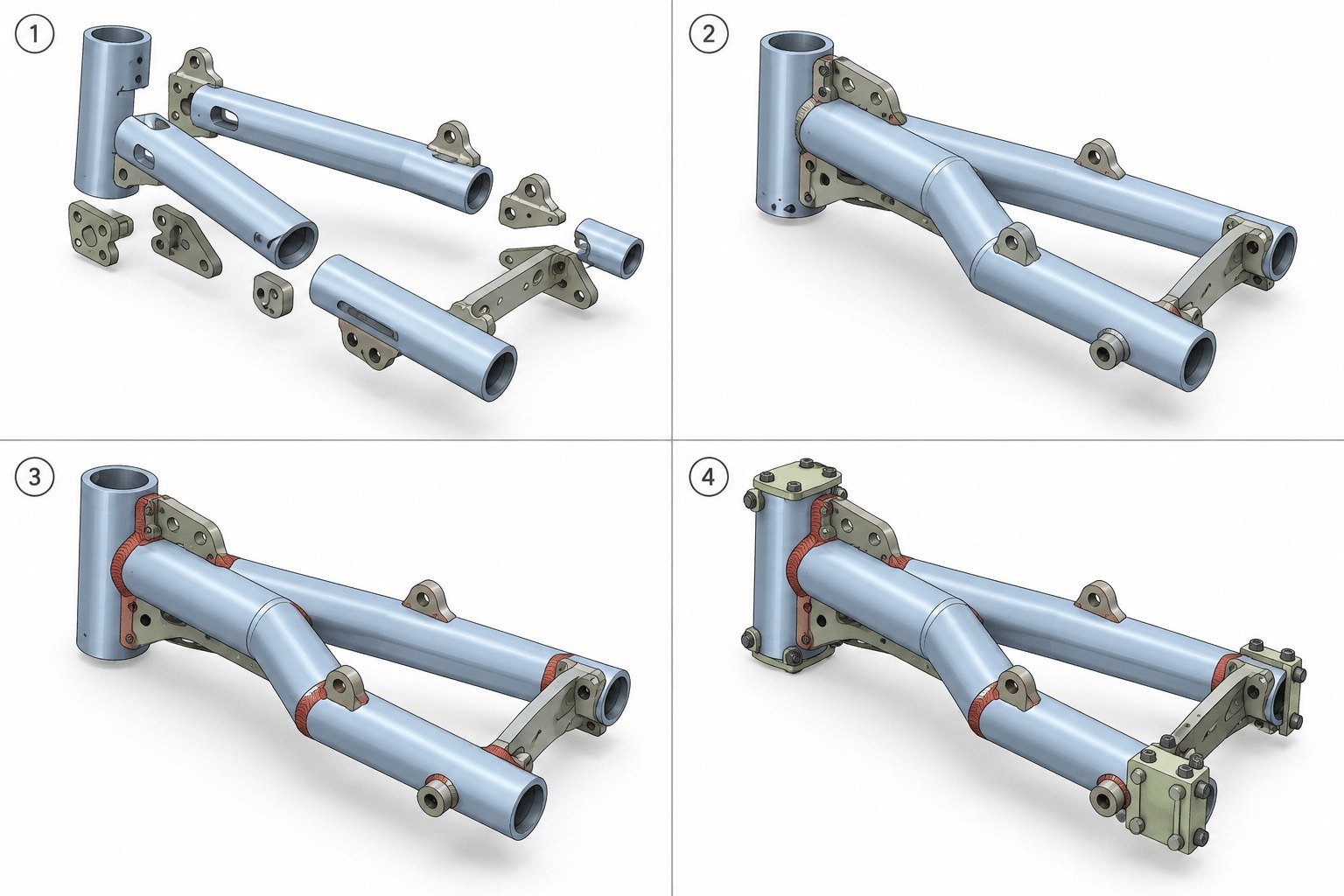
With tube laser cutting, tabs and matching slots are cut into the parts themselves so the frame assembles one way and one way only. The structure locates itself: the assembler puts the parts together, checks the diagonals and welds. Geometry repeats from the file rather than from a fixture, and assembly no longer depends on your most experienced welder being on shift.
The second effect is weld quality. When the joint is laser coped, the fit-up gap is consistent along the whole seam. A consistent gap means a stable parameter set, fewer defects and far less grinding afterwards – which matters most in robotic welding, where our ABB robots and the Fronius CMT process cannot compensate for a gap that varies from part to part.
Where the operations go: a 20-frame example
Rectangular frame from 40 × 40 × 2 mm square tube, 8 parts and 12 holes per frame, batch of 20.
| Operation | Conventional route | Tube laser route |
|---|---|---|
| Cutting to length | Cold saw, 160 cuts | Inside the cycle |
| Marking out holes | Manual, from a template | Inside the cycle |
| Drilling | 240 holes with re-fixturing | Inside the cycle |
| Corner copes | Milled or ground | Inside the cycle |
| Welding jig | Designed and built | Not required |
| Diagonal accuracy | Depends on the jig | Repeats from the file |
For a purchasing manager the relevant number is not the cutting rate but first-article lead time. Removing the jig typically takes one to two weeks out of the schedule for a new frame, and it removes the tooling line item from the quotation entirely.
When a tube laser is not worth it
- Straight 90° cuts with no holes. If all you need is blanks cut to length, a cold saw is cheaper and faster.
- Very heavy wall. Above a certain wall thickness cutting speed drops far enough that sawing plus drilling is cheaper.
- A single simple part. Programming time lands on one piece; the prototype would be faster by hand.
- Features after bending. Cutting a bent tube is limited, so sequence matters – discuss the order with tube bending before the drawing is frozen.
What to do at the CAD stage
Send a 3D model, not a drawing. STEP is required. Programming works from the solid, and a coped joint cannot be derived reliably from two projected views.
Design in the tab and slot joints. Even a single tab at each corner eliminates measuring before welding. Tab length and slot clearance depend on wall thickness – agree them with our engineers rather than guessing, because a slot that is too tight will not accept the tab once cutting tolerances are added, and one too loose defeats the purpose.
Ask for part numbers to be marked. It costs seconds per part and eliminates the classic error where two members of similar length differ by one hole. On an eight-member frame it is the cheapest quality measure available.
Specify the welds, not just the geometry. Weld size, which seams are visible and which require grinding belong on the drawing. See design support if the frame is still at concept stage.
How this fits a subcontract supply chain
Alumnita is a metal fabrication plant in Kaunas, Lithuania, part of Tututis Group, supplying frames and welded assemblies to customer drawings for OEMs across the EU. Tube laser cutting, bending, robotic welding, powder coating and assembly sit on one site, so a frame leaves as a finished, coated assembly rather than a box of parts for another supplier. Volumes run from single prototypes to series production; ISO 9001 is being implemented. Request a quote with STEP files and annual volumes.
FAQ
What is a tab and slot joint?
Tabs and matching slots cut by the laser into the parts themselves, so the structure assembles in one correct position. It replaces the welding jig and makes geometry repeatable from the file.
Which profiles do you cut?
Round, square, rectangular and oval tube, plus open profiles – angle, U and T sections.
Is it suitable for one-off production?
Yes, if the part is complex: many holes, mitre cuts or coped joints. For simple straight cuts a cold saw is cheaper.
What file format do you need?
A STEP 3D model. A drawing in two projections is not sufficient to programme a tube laser.
Related: Tube laser cutting · Welding · Laser cutting · Request a quote