
Laser cutting is cheaper as long as the part stays flat and the tolerance is no tighter than about ±0,1 mm. Milling wins the moment you need depth, threads or hundredths of a millimetre. In practice a surprising number of parts are cheapest when both processes are used on the same blank: the contour on the laser, the functional dimensions on the mill. Below are the seven criteria we actually apply when quoting, and the one drawing habit that doubles the price for nothing.
The seven criteria at a glance
| Criterion | Laser cutting | CNC milling |
|---|---|---|
| 1. Geometry | Flat, contour only | Three-dimensional, with depth |
| 2. Typical tolerance | ±0,1 mm thin sheet, ±0,2–0,3 mm thick | ±0,01–0,02 mm achievable |
| 3. Speed on thin sheet | Very high, metres per minute | Low |
| 4. Set-up | Minimal – nest, load sheet, run | Fixture, tooling, programme, first-off |
| 5. Edge condition | Square, small heat-affected zone, light dross | Clean, no heat input, defined surface finish |
| 6. Threads and pockets | Not possible | Native operation |
| 7. Material yield | High – dense nesting, 0,2–0,4 mm kerf | Lower – chips from solid stock |
Criterion 1–2: geometry and tolerance decide almost everything
These two criteria settle roughly eight out of ten parts on their own. A laser produces a two-dimensional contour through the full thickness; it cannot make a pocket, a counterbore, a seal groove or a thread. If the drawing contains any of those features, part of the part is going on a mill regardless of what the contour costs.
On tolerance, our 12 kW fibre laser holds roughly ±0,1 mm on thin aluminium and stainless. Above about 8–10 mm, thermal effects and a slight edge taper widen that to ±0,2–0,3 mm. Nothing in the drawing tighter than ±0,05 mm can be promised from a cut edge – it has to be machined.
Criterion 3–4: speed versus set-up
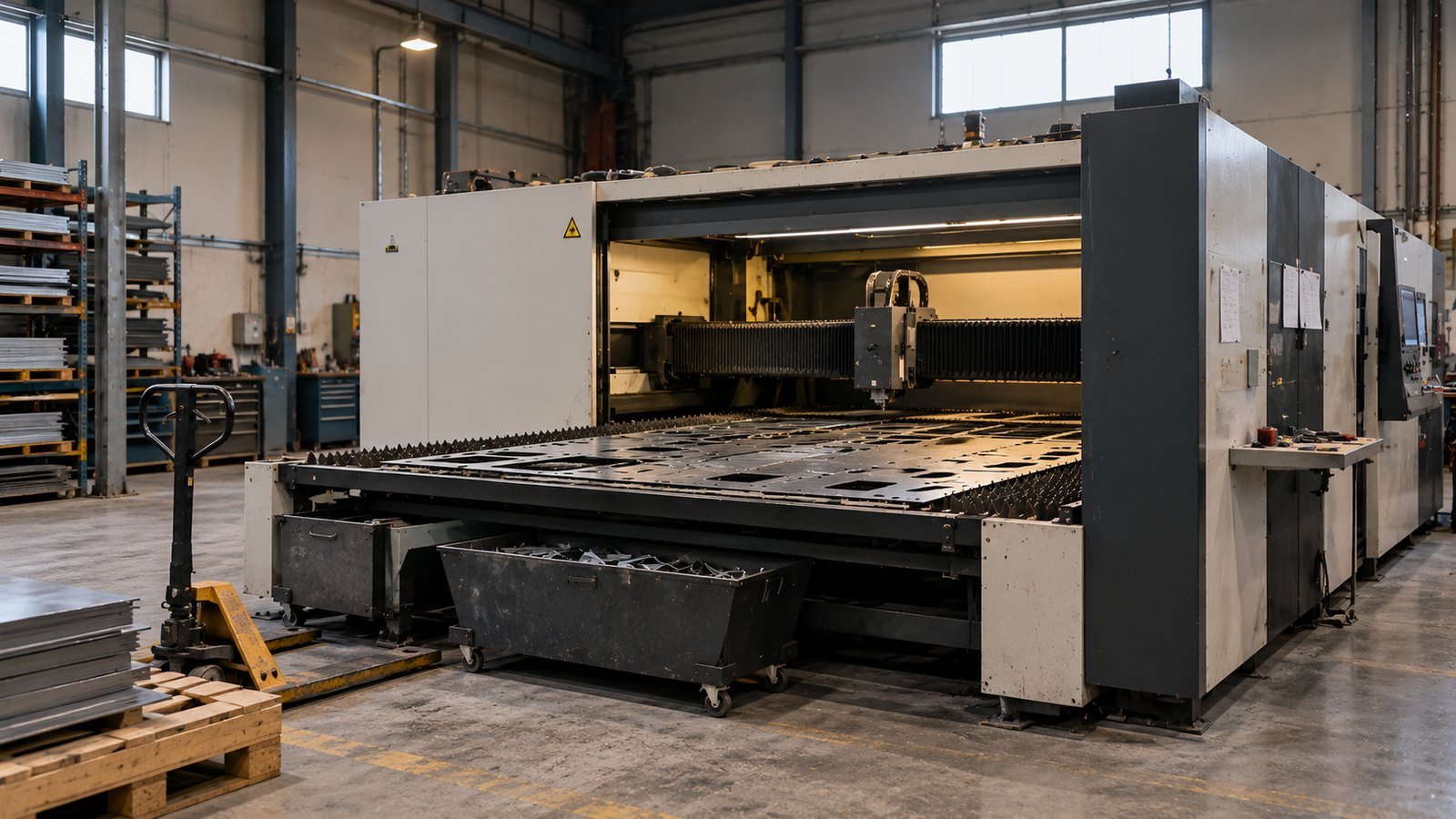
The laser has almost no set-up: the nest comes straight from your DXF or STEP, the sheet is loaded, and the machine runs. That is why a laser-cut prototype can be in your hands in days with no tooling cost at all.
Milling carries a fixed cost before the first chip: fixture design, tool selection, CAM programming, first-off inspection. Spread over 500 pieces that cost disappears into the noise. Spread over three pieces, it is most of the invoice. The crossover point is where the per-piece saving on cycle time overtakes the one-off set-up – for simple aluminium plates that is usually somewhere in the tens of pieces.
Criterion 5: what the edge is actually like
A fibre-laser edge on aluminium is square and clean enough to weld or powder coat directly in most cases, but it has a narrow heat-affected zone and can carry light dross on the underside. Two consequences worth designing around:
- Sealing and sliding faces. If a gasket or bearing runs on the edge, specify it as machined. A cut edge is not a bearing surface.
- Deburring is a cost line, not a free favour. On thicker aluminium a mechanical deburr adds handling time. Say on the drawing whether sharp edges are acceptable or a defined break is required.
Criterion 6–7: features and material yield
Threads, bearing seats and pockets are milling work, full stop. A laser-cut hole can be tapped afterwards as a separate operation, which is often the cheapest route: cut the pilot hole in the nest, tap it in a second pass. For captive fasteners, a pressed-in insert beats a machined thread on thin sheet, because below about 2,5 mm there is simply not enough material for enough thread engagement.
Material yield favours the laser by a wide margin. A dense nest typically reaches 75–85 % sheet utilisation with a 0,2–0,4 mm kerf; milling a plate out of solid turns a large share of an expensive aluminium billet into chips. On 6082 plate this difference alone can decide the comparison.
The expensive mistake: one tolerance for the whole part
The single most common cost driver we see is a general note reading ±0,05 mm applied to every dimension on the drawing. The part then has to be milled in its entirety, even though only two dimensions – say a pair of bearing bores – are functionally critical. Everything else was perfectly served by a general tolerance class to EN ISO 2768-m.
Mark the functional dimensions, give the rest a general class, and the technologist can split the operations correctly. On sheet parts this one change routinely takes 30–50 % out of the price. It is also, honestly, the only piece of information we need from you to do it.
The combined route, with a worked example
Take an aluminium mounting plate, 8 mm EN AW-6082 T6: complex outer contour, twelve free-position fixing holes, two bearing seats at H7, and a milled recess 3 mm deep.
- Laser. Outer contour and all twelve free holes, cut from a nested sheet in seconds per part, plus undersized pilot holes at the two bearing positions.
- Mill. One set-up: finish the two bores to H7, machine the 3 mm recess, break the edges.
- Finish. Deburr and coat, or ship raw if the plate is internal.
Milled from solid the same plate costs several times as much. Laser-cut only, it does not meet the drawing. The combined route exists because both machines sit in the same hall in Kaunas, so the part does not travel between operations – see our equipment list.
When neither is the right answer
- High volumes of simple flat parts. Above a few tens of thousands per year, stamping beats both on piece price, once the tool is paid for.
- Parts cut from tube or profile. A tube laser does in one operation what otherwise needs sawing, drilling and milling in three.
- Parts that only need to be bent. If the geometry is a bent profile, the cost sits in press brake bending and the number of set-ups, not in the cut.
What we need in order to quote
A STEP or DXF, the alloy and temper, the quantity per batch and per year, the functional dimensions marked, and the required finish. With that we can tell you within a working day which operations the part should go through and what it costs in series production. Send it through request a quote.
FAQ
What tolerance can a laser actually hold?
About ±0,1 mm on thin aluminium and stainless, widening to ±0,2–0,3 mm above roughly 8–10 mm thickness. Anything tighter than ±0,05 mm needs machining.
Can laser-cut holes be threaded?
Yes – the hole is cut on the laser and the thread is formed in a separate tapping or milling operation. On sheet below about 2,5 mm, a pressed-in insert is usually the better engineering choice.
Which process suits a prototype?
For a flat part, the laser – no tooling and no fixture, so the lead time is days. For a three-dimensional part, milling, accepting that the set-up cost is carried by very few pieces.
At what quantity does milling become competitive?
It depends on the feature count, but for simple aluminium plates the set-up cost usually stops dominating somewhere in the tens of pieces. Below ten, every avoidable milling operation is worth designing out.
Do you run both processes in house?
Yes. Laser cutting and CNC milling are in the same plant in Kaunas, along with bending, welding, assembly and the coating line, so parts do not move between suppliers mid-route.
Related: Laser cutting · CNC milling · Contract manufacturing · Request a quote