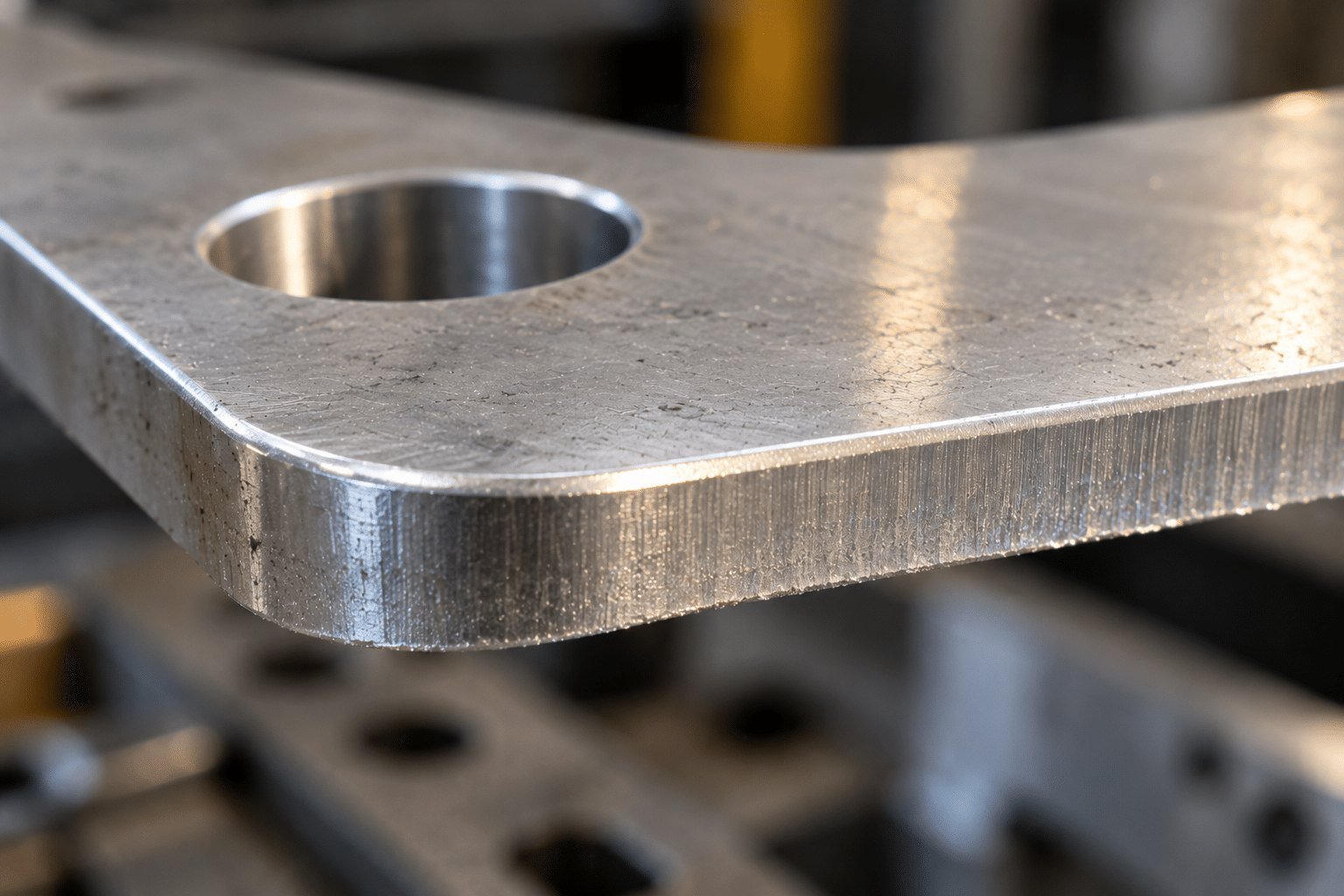
Aluminium is laser cut under high-pressure nitrogen, so the cut edge stays free of oxide and goes straight to welding or powder coating without a secondary cleaning operation. Cuttable thickness is set by laser power, but the price of the finished part is driven far less by cut length than by sheet utilisation and the number of pierces.
Why aluminium is cut with nitrogen, not oxygen
Carbon steel can be cut with oxygen – the exothermic reaction does part of the work. Aluminium cannot: oxygen forms a hard aluminium oxide on the cut face that ruins the edge and interferes with both painting and welding. Aluminium is cut with high-pressure nitrogen instead, which keeps the kerf inert and blows the molten metal out of the cut.
The second issue is reflectivity: aluminium absorbs the 1 µm wavelength of a fibre source far better than the 10.6 µm of CO2, which is why fibre is now the default for sheet laser cutting in aluminium.
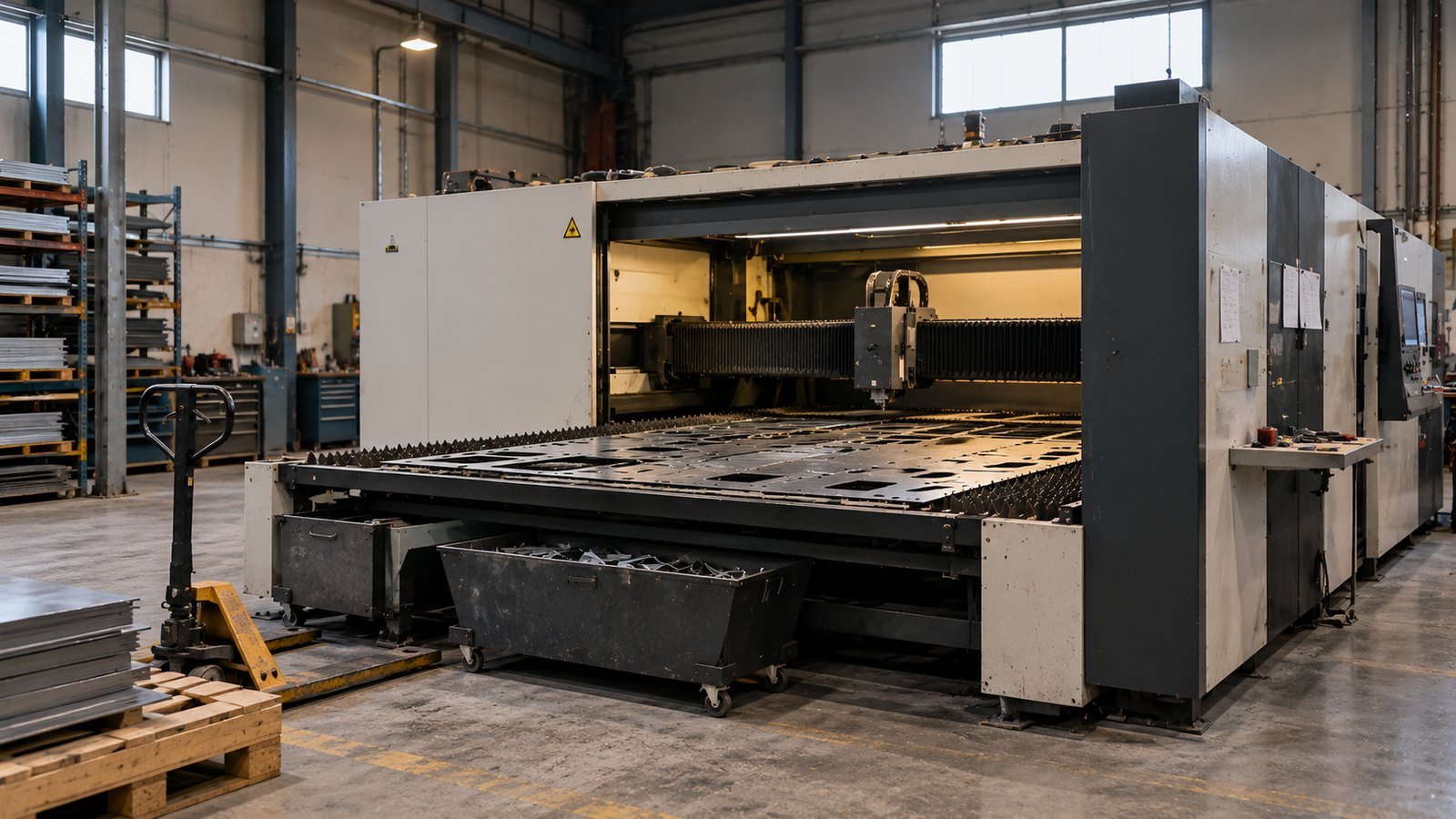
Our sheet laser
| Parameter | Value |
|---|---|
| Source | 12 kW fibre |
| Working area | 4000 × 2000 mm |
| Positioning accuracy | ±0.02 mm |
| Positioning speed | up to 80 m/min |
| Materials | aluminium, carbon steel, stainless 1.4301 and 1.4404 |
Positioning accuracy is not part tolerance. Thermal input, sheet flatness and clamping add to it, so for a cut-only aluminium part plan on roughly ±0.1 mm on small features and more across a 2 m span. If the drawing asks for tighter, the feature belongs in CNC milling.
Design limits worth knowing
- Kerf width – 0.2–0.5 mm, growing with thickness. Do not model it into the CAD geometry; CAM compensates for it.
- Minimum hole – diameter not smaller than sheet thickness. Below that the hole is drilled, not cut.
- Minimum web between contours – at least one material thickness, otherwise the web overheats and distorts.
- Edge quality – specify to EN ISO 9013 rather than writing "good quality" in a note. The standard gives both parties a measurable reference.
- Burr – aluminium always burrs more than stainless. For hand-contact or mating surfaces, schedule deburring as a separate, priced operation.
- Holes near bend lines – closer than about 2.5× thickness to the bend they will deform in press brake bending.
The alloy matters more than buyers expect
| Alloy | Typical use | Behaviour in cutting and forming |
|---|---|---|
| EN AW-1050 | Electrical, decorative trim | Soft, burrs heavily, excellent formability |
| EN AW-5754 | Folded enclosures, brackets | Cuts cleanly, our default grade for bent parts |
| EN AW-5083 | Marine environments, thicker plate | Cuts well, good corrosion resistance |
| EN AW-6082 T6 | Structural, load-bearing frames | Harder, very clean edge, cracks on a tight bend radius |
The most common drawing omission is no alloy at all, just "aluminium 3 mm". State alloy and temper even if you are unsure it is the right one – our engineers will propose an alternative against a stated baseline, which is far easier than guessing from a blank. See aluminium fabrication for the grades we run routinely.
What actually makes up the price
- Sheet utilisation. The outline decides how many parts fit on a 4000 × 2000 mm sheet. One changed corner radius or a 3 mm narrower flange sometimes fits another full row into the nest.
- Number of pierces. Every internal hole needs a pierce, and piercing thick aluminium takes longer than cutting the contour around it. A perforated panel is priced by hole count, not by area.
- Batch size. Ten pieces and one hundred off the same nest are different unit costs. Ask for price breaks at 1, 10, 50 and 250 off – that shows where the real economies sit.
- Downstream operations. Bending, tapping, welding and powder coating. Done on one site, intermediate packing, transport and goods-in inspection disappear – usually a larger saving than the cutting itself.
When laser cutting is the wrong choice
- Tolerance tighter than ±0.05 mm. Thermal cutting will not hold it; mill the feature instead.
- High volume, very simple outline. Above a few thousand pieces of a flat washer-like part, stamping wins on unit cost even after tooling.
- Deep three-dimensional geometry. A laser cuts in a plane; shape comes from bending or milling.
Data package and quoting as a subcontractor
DXF is enough for a flat, cut-only part. STEP is required as soon as the part is bent or welded, because the flat pattern has to be derived from the solid. A PDF drawing belongs alongside the model for tolerances, thread callouts and surface notes, but cannot be cut from on its own. A usable file has closed contours, no duplicate lines, stated alloy and temper, thickness, quantity, and a note marking which faces are visible after assembly.
Alumnita is a metal fabrication plant in Kaunas, Lithuania, part of Tututis Group, working to customer drawings for OEMs across the EU, from prototypes through to series production. ISO 9001 is being implemented. Request a quote with your DXF or STEP files and quantities.
FAQ
What is the maximum sheet size you cut?
Up to 4000 × 2000 mm. Larger parts are either split into sections and joined, or agreed separately.
Do laser cut aluminium edges need cleaning before painting?
Nitrogen cutting leaves an oxide-free edge suitable for powder coating as cut. Aluminium does retain burr, so deburring should be specified separately for parts that are handled or that mate with other components.
Can I order cutting only?
Yes. We supply single operations as well as complete assemblies including bending, welding, powder coating and final assembly.
Which alloy should I choose for a bent bracket?
EN AW-5754 for tight bend radii, EN AW-6082 T6 where structural strength matters and bends are generous. 6082 T6 will crack on a radius that 5754 tolerates.
Related: Laser cutting · Aluminium · Sheet metal fabrication · Request a quote