
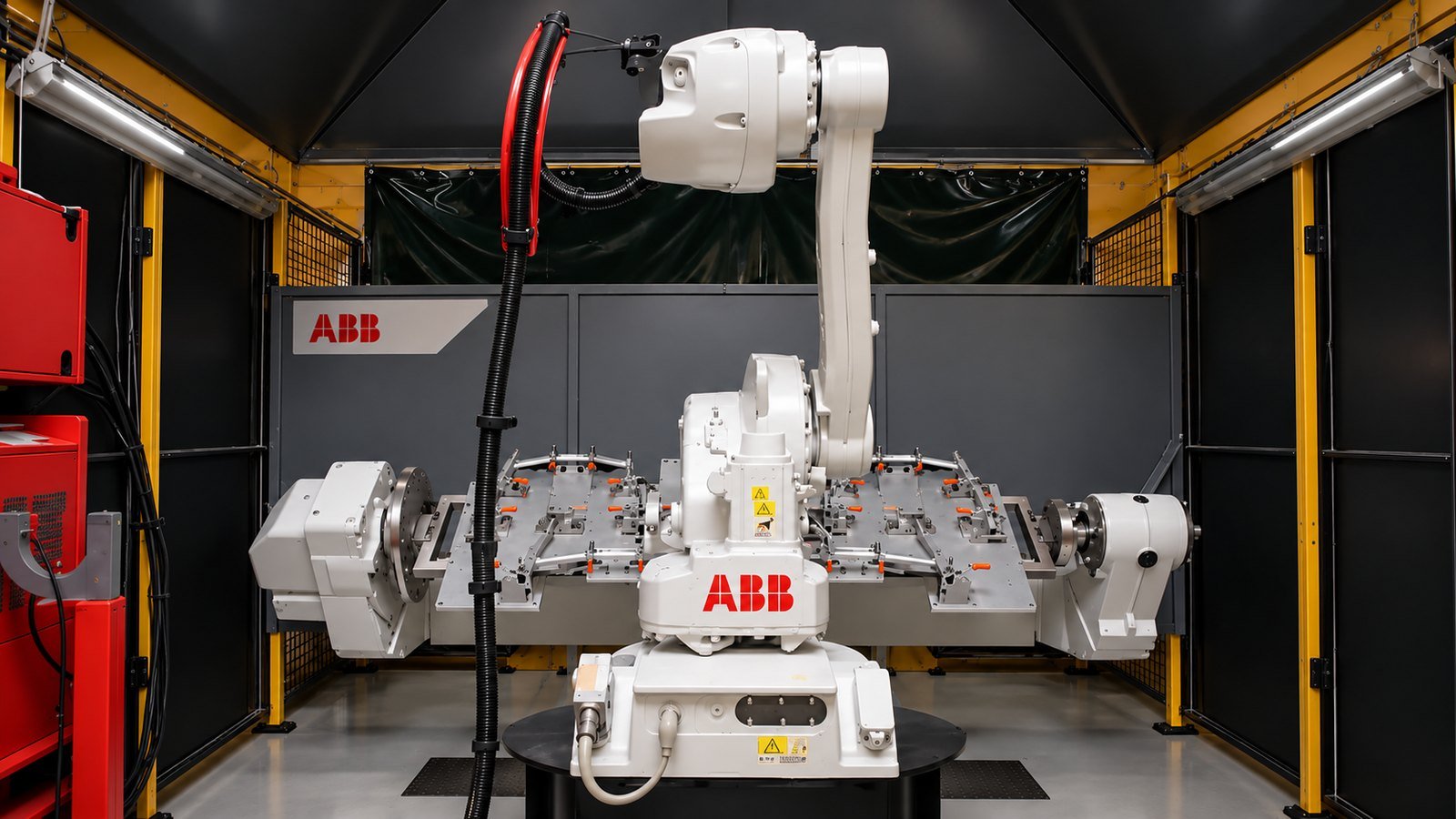
Aluminium conducts heat about three times better than steel, so thin sheet distorts fast and manual weld quality depends on the welder having a good day. Robotic welding with the Fronius CMT process answers both – but only above a certain batch size. Here is what CMT does, how we set it up for EN AW-5754 and EN AW-6082 T6, and where the break-even really sits.
What CMT actually is
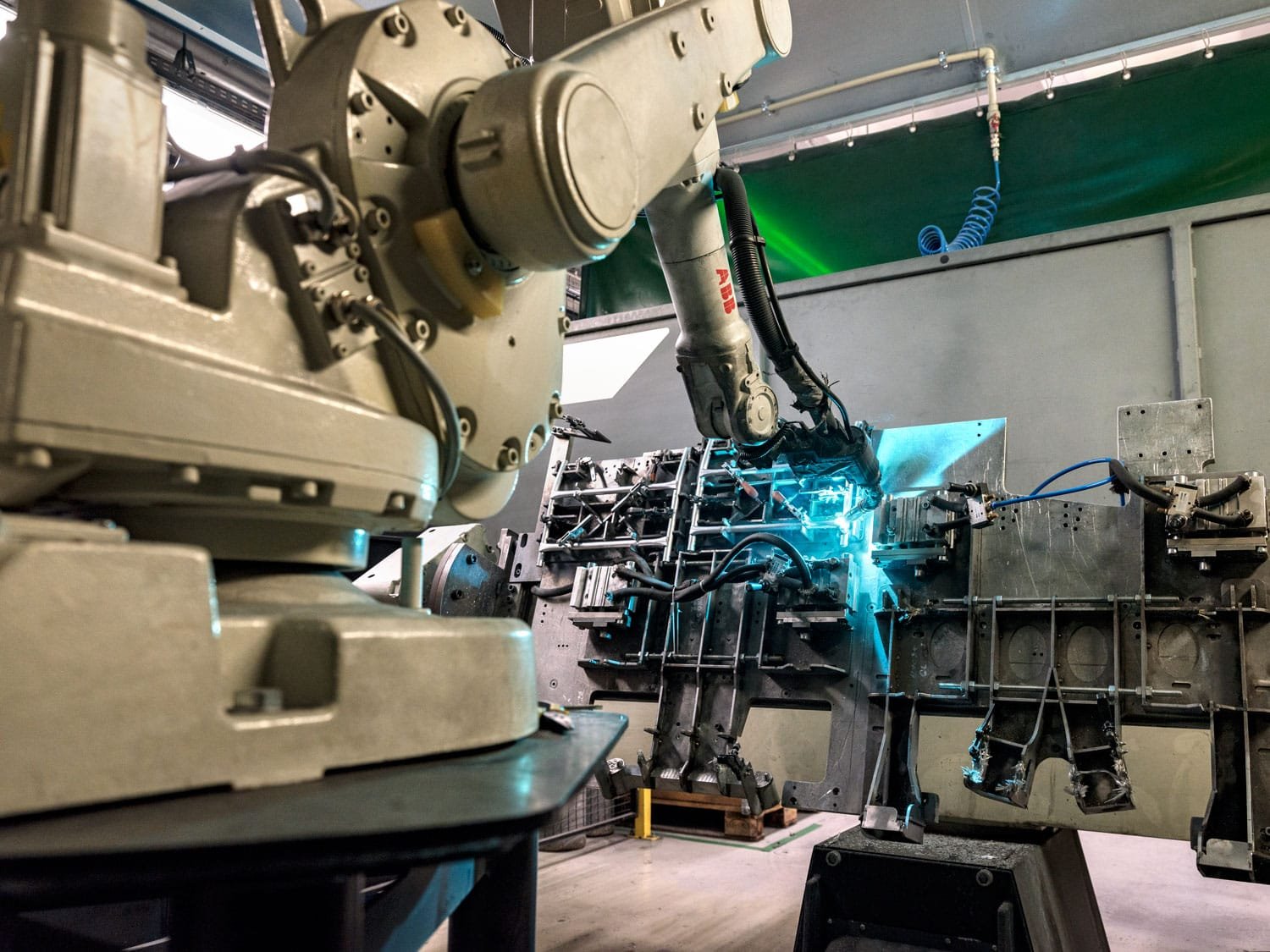
CMT means Cold Metal Transfer: a controlled short-arc MIG variant in which the wire feed is mechanically reversed. When the wire touches the pool and short-circuits, it is retracted, the droplet detaches at near-zero current, and the arc re-ignites – up to about 70 times per second.
- Low heat input – current collapses during droplet transfer, so energy per millimetre of seam is far below spray-arc MIG.
- Almost no spatter – the droplet is placed, not thrown, which removes a dressing operation before powder coating.
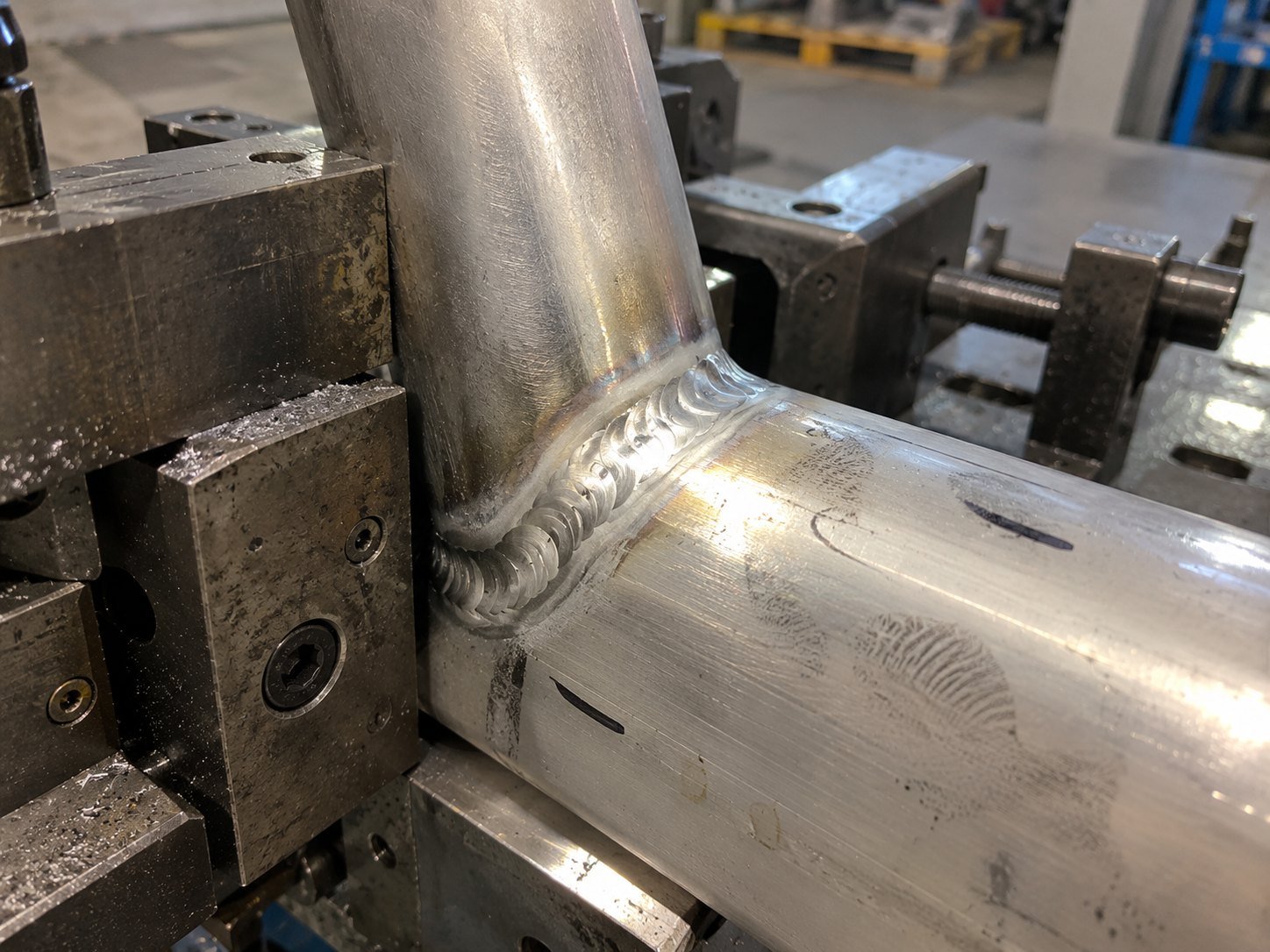
- Gap tolerance and repeatability – the short, stable arc bridges a root gap of a few tenths without burn-through, and part 2000 looks like part 20.
Why aluminium is the hard case
- Oxide layer – Al₂O₃ melts near 2050 °C, the base metal at about 660 °C. Oxide left on the joint becomes an inclusion.
- Thermal conductivity – around 235 W/mK against roughly 50 for steel: heat runs away, so energy must arrive fast.
- Hot cracking – 6xxx alloys are sensitive to solidification cracking, which makes filler choice structural, not cosmetic.
- Distortion – expansion is roughly twice that of steel; on 1.5–3 mm sheet a conventional MIG pass can pull a 1 m frame millimetres out of flat.
One more point for the design engineer: the heat-affected zone in EN AW-6082 T6 loses a large part of its strength, commonly 30–40 %, and does not recover without re-ageing. Place seams away from peak stress, or size the section for HAZ strength to EN 1999-1-1.
Filler wire: ER5356 or ER4043
| Filler | Suits | Strength | Limit |
|---|---|---|---|
| ER5356 (AlMg5) | EN AW-5754 and other 5xxx | Higher shear strength and ductility; anodises close to the base metal | More crack-sensitive on some 6xxx geometries |
| ER4043 (AlSi5) | EN AW-6082 T6 extrusions | Lower melting point, better flow, much lower cracking risk | Lower strength; turns dark grey if anodised |
In practice we weld 5754 sheet assemblies with ER5356 and 6082 T6 frames with ER4043, unless the joint is loaded in shear. Note on the drawing if the part will be anodised – that single line changes the wire.
Shielding gas and preparation
Pure argon at 99.996 % purity covers most work, at roughly 14–18 l/min – more than for steel, because the gas has to cover a pool that oxidises instantly. Above about 6 mm an argon–helium mixture raises arc energy and travel speed, at a clearly higher gas cost.
Preparation is not optional: degrease with solvent, remove oxide with a stainless brush used only on aluminium, and weld within hours rather than days. Cutting oil, marker pen and anodised edges all come back as porosity. Blanks from our own laser cutting are cut dry and go straight to the cell.
Fixtures, jigs and tab-and-slot blanks
A robot does not find the joint; the fixture puts the joint where the robot expects it. Fixture design is the largest single engineering cost in a robot project, and the cheapest way to cut it is in the part design.
- Tab-and-slot blanks – self-locating features cut on the same laser as the profile, so the jig only clamps rather than locates.
- Laser-cut tube ends – coped and notched on the tube laser for a consistent fit-up gap instead of a sawn end.
- Torch access – an interior corner a hand torch reaches may be unreachable for a robot wrist. We check this on the model before quoting.
The real break-even question
Robotic welding is cheaper per part and more expensive per project: programming and the fixture are both spent before the first good part.
| Factor | Manual MIG / WIG | Robot with CMT |
|---|---|---|
| Setup per new part | Minutes | Programming plus fixture build |
| Cycle time, multi-seam frame | Baseline | Typically 30–60 % shorter |
| Consistency | Depends on the operator | Identical part to part |
| Economic from | 1 piece | Repeating annual volume |
As a rule of thumb, an aluminium frame with long total seam length and a stable drawing starts to pay as a robot job in the low hundreds of units per year, and pays decisively when it repeats over several years in series production. A part with three short seams rarely does, however many you order. We calculate it from your drawing and annual quantity – ask via request a quote.
Quality levels to ISO 10042
Aluminium arc welds are assessed to ISO 10042, which sets quality levels B, C and D for porosity, undercut and excess penetration, B being strictest. State the level on the drawing next to the seam symbol. Level B on every seam of a non-structural cover raises cost without benefit; stating nothing means quotation and inspection may assume different things. Porosity is where aluminium most often fails – and that is decided by preparation, not by the robot.
When not to choose robotic CMT
- One-offs and prototypes – manual MIG or WIG is faster and cheaper, and we use it deliberately.
- Unstable design – if the drawing is still moving, a fixture built now is scrap in two months.
- Very thin material – below roughly 1 mm laser welding gives a narrower heat-affected zone; a laser welding work centre is joining our shop for exactly these parts.
- Parts that do not fit a cell – large weldments needing manual positioning while welding.
FAQ
From what quantity does robotic welding pay off?
It depends on seam length, number of seams and annual repeat volume rather than one number. We evaluate it from the drawing and give you a manual-versus-robot comparison with the quotation.
Can you weld EN AW-6082 T6 without losing strength?
No process avoids softening in the heat-affected zone of a T6 temper. CMT keeps the zone narrow, but the joint must be designed for reduced HAZ strength.
Who pays for the fixture?
Normally the customer, as a one-off tooling item quoted separately and reserved for that part. Tab-and-slot features in the blank reduce what it costs.
Do you weld steel in the same cells?
Yes – 1.4301 and 1.4404 stainless and carbon steel run in the same robotic welding cells with different wire and gas settings.
Related: Welding · Aluminium fabrication · Request a quote