
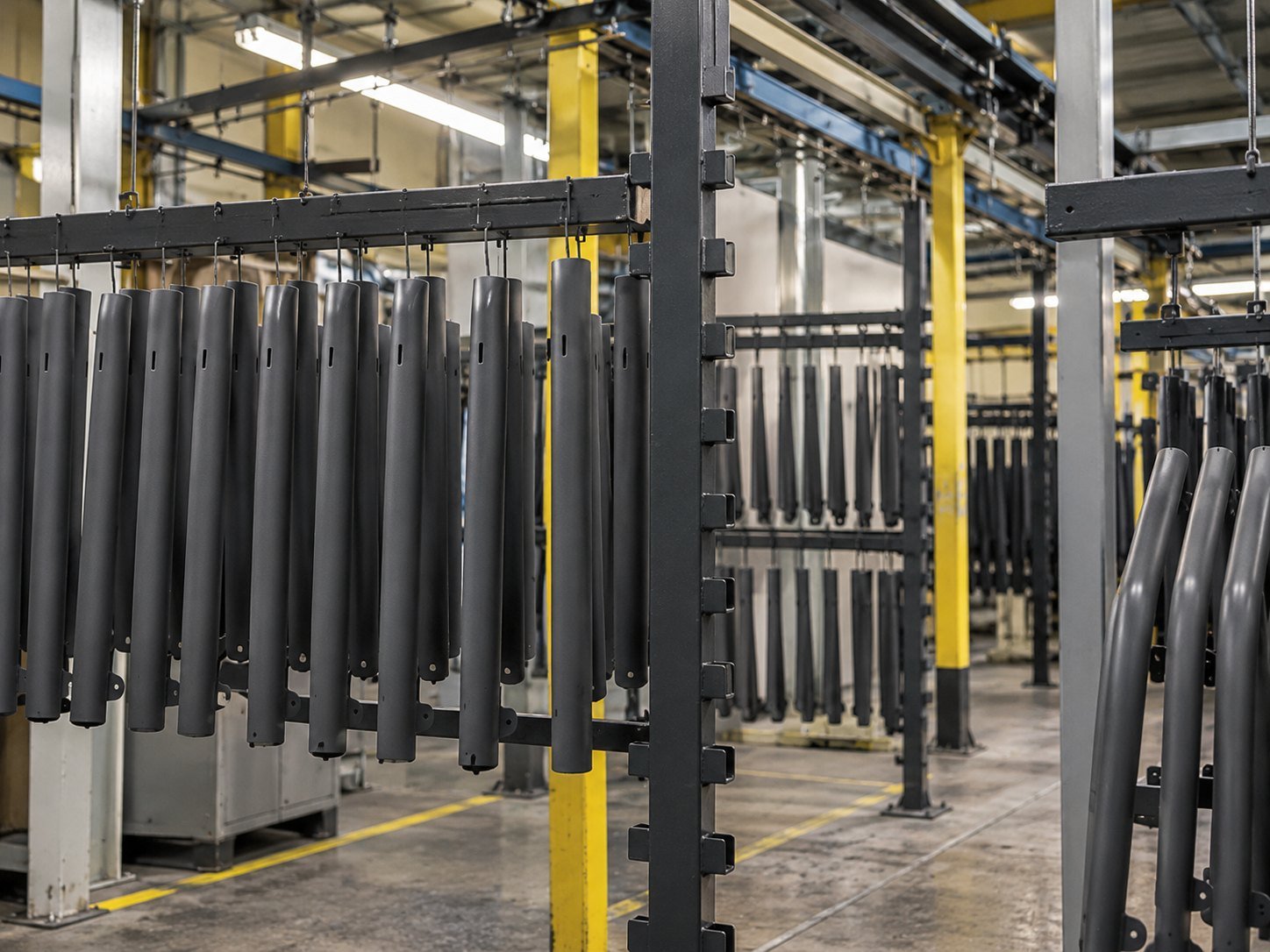
Long frames, racks, partitions and structural profiles rarely fit a small coating shop, so manufacturers either cut them into pieces or ship them a long way. Both cost money: splitting adds welding and assembly, transport adds lead time and the risk of damaging the finish. Our line takes parts up to 7 m in one piece – here is what that means in practice, and what decides whether your long part can be coated at all.
What fits in the booth
The oven and line length, not the gun, is the real constraint in large-part coating. These are the limits of our in-house line.
| Parameter | Value |
|---|---|
| Booth dimensions | 7000 × 1400 × 2600 mm |
| Maximum weight | 430 kg |
| Pre-treatment | Automatic chemical |
| Capacity | Up to 1,000,000 m² per year |
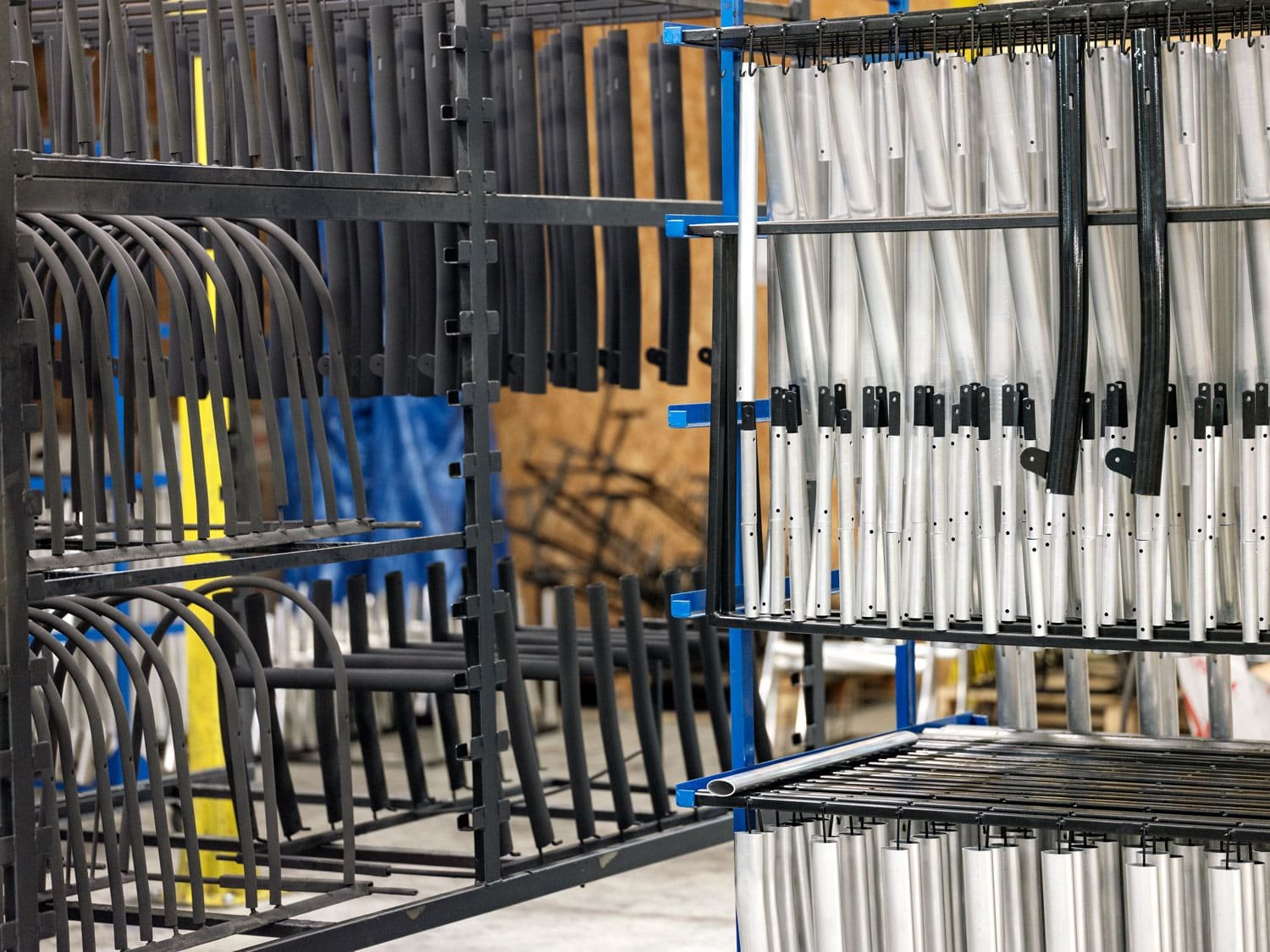
Handling and hanging a 7 m part
Everything about a long part is decided by how it hangs. A 7 m aluminium profile weighing 40 kg is not heavy, but it is flexible: hung from one point it sags, touches the booth or the oven wall, and the coating is ruined after curing rather than before.
- Two or more hanging points – spaced to keep deflection within a few millimetres over the full length, and strong enough to carry the part hot, when aluminium is weaker than at room temperature.
- Witness marks are unavoidable – every hook leaves a small uncoated or thin spot. The question is not whether, but where. Mark acceptable locations on the drawing, ideally on a hidden face or inside a bolt hole.
- Existing holes first – if a fixing hole can double as a hanging hole, nothing extra is needed. If not, a 6–8 mm hole added at the laser cutting stage costs nothing.
Pre-treatment of long profiles
Pre-treatment determines adhesion and corrosion resistance, and on a long part it is the stage where geometry bites. Our automatic chemical pre-treatment degreases, etches and rinses the whole part in one pass, which is why a 7 m profile does not have to be treated in sections – a sectioned treatment leaves a visible transition.
For aluminium the chemistry differs from steel, and a mixed-material welded assembly is always a compromise. Tell us the alloy: EN AW-5754 sheet and EN AW-6082 T6 profiles behave differently in etching, and aluminium mixed with steel brackets in one frame needs a process that suits both.
Geometry decides whether a long part can be coated
This is the section most often skipped at design stage, and the one that causes rejections. Chemistry and rinse water must get in and, more importantly, get out.
- Drain holes in closed sections – any closed tube or box must have holes at both ends, positioned so that liquid runs out in the hanging orientation. Trapped liquid boils in the oven and blows the coating off locally.
- Blind pockets – a pocket that holds a tablespoon of rinse water will leave a stain that cannot be polished out. Add a 6 mm drain at the low point.
- Fully welded seams – an interrupted seam on an otherwise sealed box traps chemistry in the gap and bleeds it out weeks later. Either weld it continuously or leave an honest opening.
Masking threads and machined faces
Powder has no respect for a tapped hole: 80 µm of polyester on an M8 thread makes it unusable. Masking is cheap when planned and expensive when it has to be re-worked after curing.
- Mark every masked feature on the drawing – threads, bearing seats, earthing points, sealing faces, sliding surfaces.
- Earthing points – a machine frame usually needs one deliberately uncoated, electrically conductive area. Specify it or it will be coated.
Film thickness and Qualicoat classes
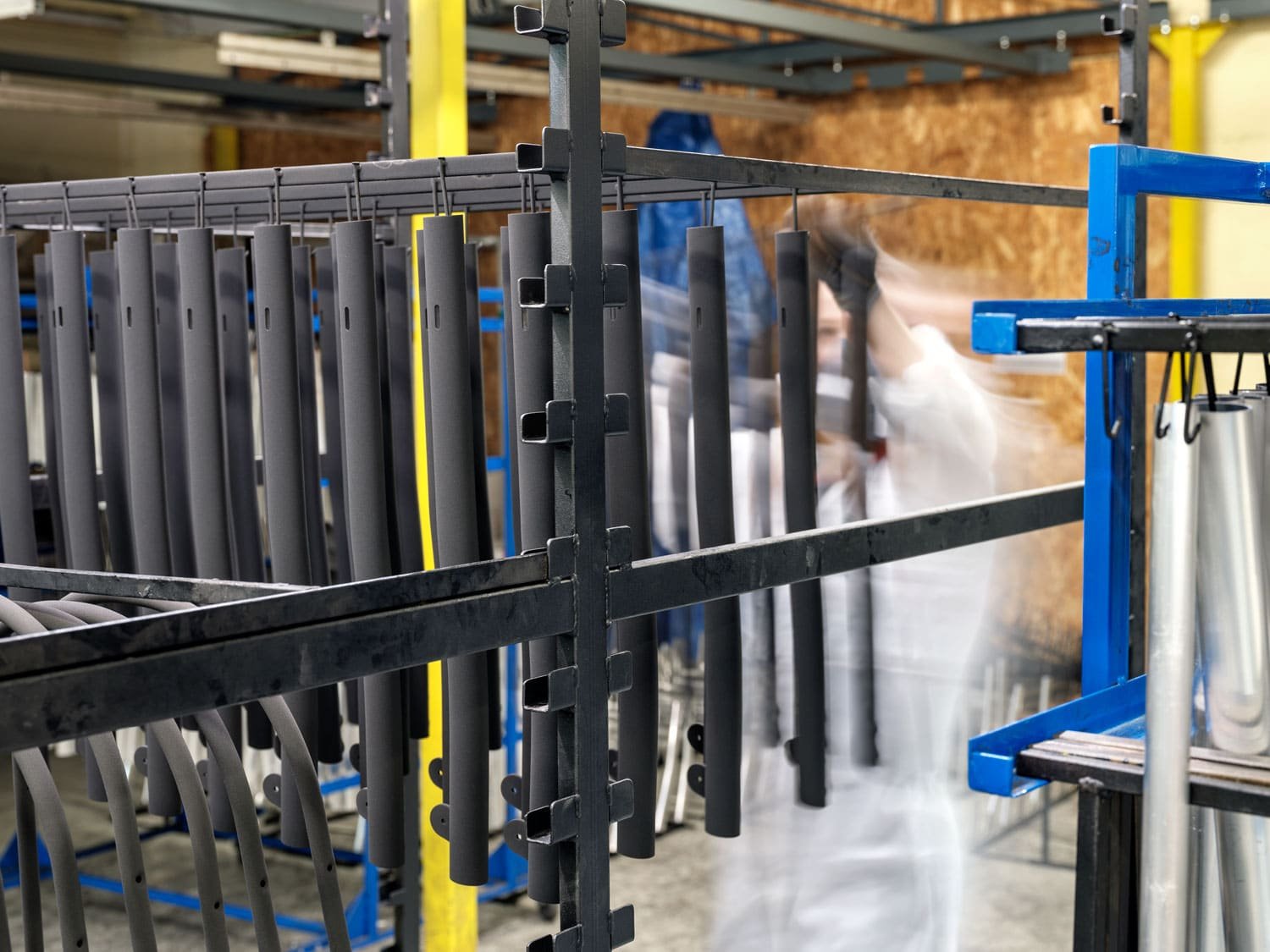
Film thickness is specified, measured and reported, not estimated. A typical architectural finish on aluminium is 60–80 µm; thin edges and thick inside corners are normal, which is why specifications state a minimum rather than a nominal value.
| Specification | Typical use | Note |
|---|---|---|
| Class 1 polyester | Interior, machine frames, general industry | Standard durability, widest RAL availability |
| Class 2 superdurable | Facades, exterior architectural parts | Better gloss and colour retention outdoors |
| Qualicoat Seaside | Coastal and marine environments | Intensified pre-treatment, not just a different powder |
Seaside class is a pre-treatment requirement first and a powder choice second – which is exactly why the drain holes above matter more on a coastal project than anywhere else. We offer Qualicoat Seaside class coating for these projects; state the environment, not only the RAL number.
Transport and packaging of long coated parts
A coated 7 m part is finished goods with a soft surface, and most damage happens after the oven. Protective film, interleaving, and a frame or rack that supports the part at several points rather than two are what arrive undamaged. Fully palletised long parts need a truck with the right loading length, so agree the packaging standard before the first batch rather than after the first claim – and tell us if the parts go directly to a site rather than to your warehouse.
What to send for a quote
- Overall dimensions – length, width, height including protrusions, plus weight per part.
- Material and alloy – aluminium grade, steel, or a mixed assembly.
- RAL number and gloss level, and the class or Qualicoat requirement.
- Masked features – marked on the drawing.
- Quantity and repeat frequency – one-off or recurring batches.
- Whether we also fabricate – cutting, bending and welding in one place removes the transport step entirely.
Send it through request a quote and we will confirm whether the part fits the line before anything else.
FAQ
What is the longest part you can coat?
Up to 7000 mm long, 1400 mm wide and 2600 mm high, up to 430 kg.
Can you coat a single large part, or only series?
Both. We coat one-off items and recurring batches on the same line.
Will the hanging points be visible?
Yes, every hook leaves a small mark. Tell us on the drawing which faces may carry them and we will hang the part accordingly.
Do you coat steel as well as aluminium?
Yes, including mixed welded assemblies, though the pre-treatment is then a compromise between the two materials and should be agreed in advance.
Related: Powder coating · Welding · Request a quote