
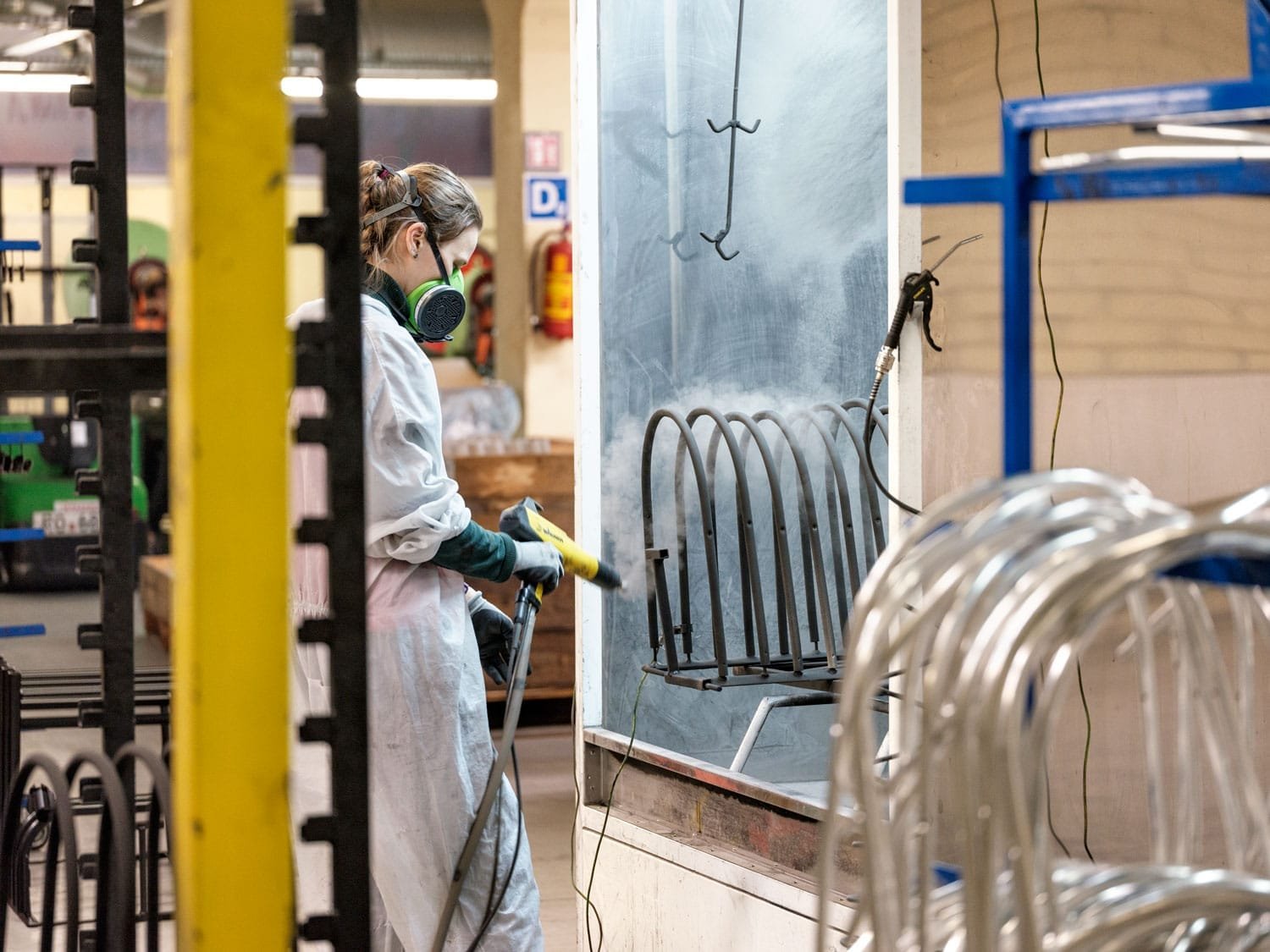
Most powder coating failures on aluminium are not caused by the powder or by the oven. They are decided minutes earlier, in the pre-treatment line. Aluminium forms a thin oxide film the moment it meets air, and powder sprayed onto that film can look perfect on the day of delivery and still flake after two winters outdoors.
Why aluminium is not steel
Steel is usually degreased, phosphated and dried. Aluminium needs a different chemistry. The natural oxide layer has to be removed or converted, and a conversion coating has to be built on the bare metal so the powder has something to bond to. Skip that step and you are relying on mechanical grip alone, which is what fails first when the part is exposed to UV, salt and temperature cycling.
This is why a supplier that coats mixed steel and aluminium work on one line, with one chemistry, is a risk for architectural and outdoor parts. Ask what the aluminium process actually is.
The four stages that decide service life
- Degreasing. Removes rolling oils, cutting fluid residue from laser cutting and handling contamination. Anything left here shows up as craters in the film.
- Etching / oxide removal. Strips the natural aluminium oxide and any heat tint left by welding.
- Conversion coating. Builds a chemically bonded layer, chromium-free in modern lines, that anchors the powder and slows filiform corrosion under the film.
- Rinsing and drying. Demineralised rinse and full drying before the booth; trapped moisture in hollow sections is a classic cause of blistering.
What to ask a powder coating supplier
- Is pre-treatment an automated chemical line, or manual cleaning and solvent wipe?
- Which chemistry is used specifically for aluminium, and is it chromium-free?
- What dry film thickness is specified, and how is it measured and recorded?
- Can adhesion results be supplied, for example a cross-cut test to EN ISO 2409?
- For coastal or industrial exposure, is a higher durability class offered?
Design decisions that affect the finish
A large share of coating problems are designed in, not caused in the plant. Three details are worth fixing on the drawing:
- Drain and vent holes. Closed profiles and welded box sections must let pre-treatment chemistry and rinse water out. Without them, liquid sits inside and bleeds out in the oven.
- Hanging points. Every part hangs somewhere, and the contact point stays uncoated. Put a hole or lug where the finish does not matter, and mark it on the drawing rather than leaving it to the line operator.
- Masking. Threads, bearing seats and earthing contacts need to be masked. Flag them on the drawing; masking added at the last minute is slow and inconsistent.
How the line works at Alumnita
Our coating line in Kaunas runs automated chemical pre-treatment with Wagner application equipment. The booth takes parts up to 7000 × 1400 × 2600 mm and 430 kg, with capacity up to one million m² per year and the full RAL range in matt, satin, gloss and textured finishes.
Because cutting, forming, welding and coating all sit under one roof, parts are not trucked between subcontractors between operations. That removes the handling damage, the transport days and the question of who is responsible when a coated part arrives scratched. For buyers this is the practical argument for single-source sheet metal fabrication.
Typical parts we coat
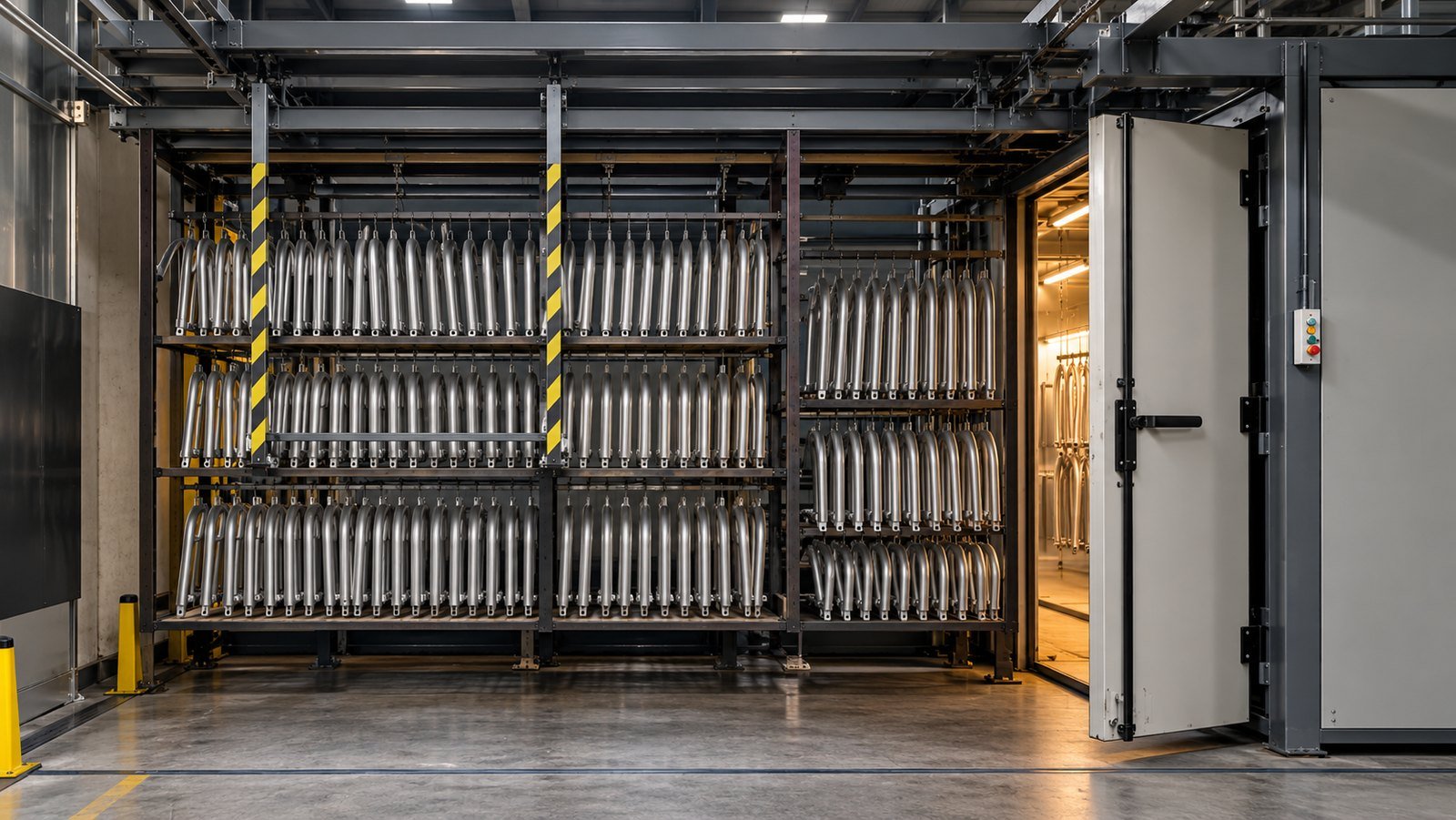
Machine frames and guards, enclosures and cabinets, outdoor furniture frames, facade and balcony elements, fencing and gate sections, agricultural machinery components and aluminium profiles cut to length.
FAQ
Why does powder coating peel off aluminium?
Almost always insufficient surface preparation. If the oxide layer is not removed and no conversion coating is formed, the powder has nothing to bond to and the film releases once moisture reaches the interface.
What thickness of powder coating is normal?
For indoor parts roughly 60–80 µm, and for outdoor exposure typically 80–120 µm. The correct figure depends on the finish and the exposure class, and it should be agreed before production, not after.
Can you coat welded assemblies?
Yes. Weld seams are cleaned and the heat tint is removed in pre-treatment. Closed assemblies need drain and vent holes so the chemistry can escape.
How much does powder coating cost?
It is quoted per job, based on surface area, part size, batch quantity and colour. Send a drawing or a photo with dimensions and we will come back with a price and a lead time.
Related: Powder coating service · Aluminium fabrication · Request a quote