
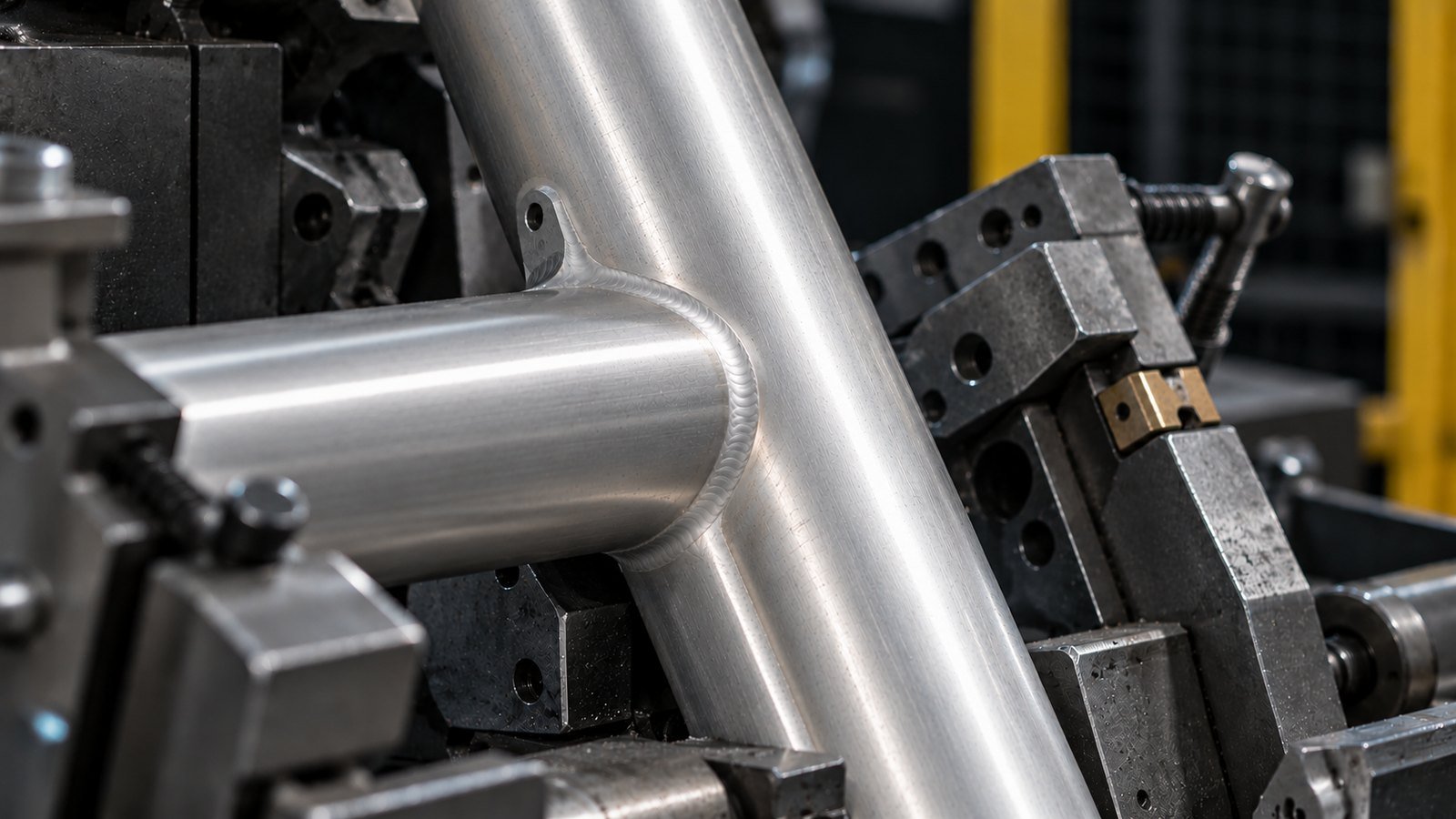
Laser welding focuses the beam into a spot a few tenths of a millimetre across, reaching a power density no arc process can match. The practical consequence is simple: the metal heats only where the seam is. For thin-wall enclosures, stainless steel products and cosmetic seams this means less distortion, a narrower heat-affected zone and, very often, no grinding at all.
Two modes: conduction and keyhole
Two laser welding modes decide seam shape and penetration depth, and a technologist should specify which one a part needs.
- Conduction mode. Lower power density, the material melts near the surface only. The seam is wide and very smooth – used where the weld is visible and appearance matters more than penetration.
- Keyhole mode. The beam creates a vapour capillary in the material, so penetration is deep and the seam narrow; depth-to-width ratios of 5:1 and higher are normal. This is the mode that welds in a single pass a butt joint that MIG would need several layers for.
On top of that comes wobble (beam oscillation) – the beam is swept in a small circle or figure-of-eight. It increases the allowable gap between parts and improves seam cosmetics, which is why oscillation usually solves the main objection to laser welding: tight fit-up requirements.
Laser welding vs MIG/MAG and TIG
| Criterion | Laser | MIG/MAG | TIG |
|---|---|---|---|
| Heat input | lowest | high | medium |
| Heat-affected zone (HAZ) | narrow | wide | medium |
| Distortion in thin sheet | low | high | medium |
| Welding speed | very high | high | slow |
| Seam appearance | narrow, clean | wider, raised bead | clean but slow |
| Fit-up tolerance | tight | forgiving | medium |
| Post-weld finishing | often none | grinding, polishing | minimal |
When laser welding pays off
- Thin sheet, 0.5–3 mm. Stainless steel and aluminium enclosures, boxes and covers where MIG would pull the geometry out of tolerance.
- Visible seams. If an arc weld would have to be ground and polished anyway, the laser removes that work instead of moving it to the next operation.
- Series production and repeatability. A programmed path reproduces the same seam without operator variation – decisive when the part is inspected visually or measured.
- Leak-tight products. A continuous, pore-free seam suits housings that have to hold pressure or keep liquids out.
- Parts with a lot of weld length. Where metres of seam dominate the cost, speed translates directly into a lower cost per part.
When it is the wrong choice
Laser welding is not a universal replacement. For heavier structures that need filler metal and tolerate wider gaps, robotic MIG/MAG or TIG remain cheaper and more robust. The same is true for one-off parts whose fit-up is not controlled – an arc process forgives far more.
What to prepare on the drawing
Fit-up is what decides laser welding: without oscillation, the gap between parts should stay within roughly 10 % of the thinner wall thickness. Blank accuracy therefore matters more than the welding step itself.
- Cut the blanks by laser so the edge is straight and burr-free.
- Design in tab & slot features that locate the parts without a separate fixture.
- State which seams are continuous and which are stitch or spot welds.
- For cosmetic seams, mark the surface class and the grain direction on the drawing.
- If the part will be painted, remember that powder coating hides small surface marks but never distortion.
Materials
We laser weld stainless steel (1.4301, 1.4404), carbon steel and aluminium alloys. Aluminium is the more demanding material because of its reflectivity and thermal conductivity, so parameters follow the alloy: sheet grades such as EN AW-5754 and structural EN AW-6082 T6 behave differently. Suitability for a specific part is assessed from the drawing and the joint type.
How it works at Alumnita
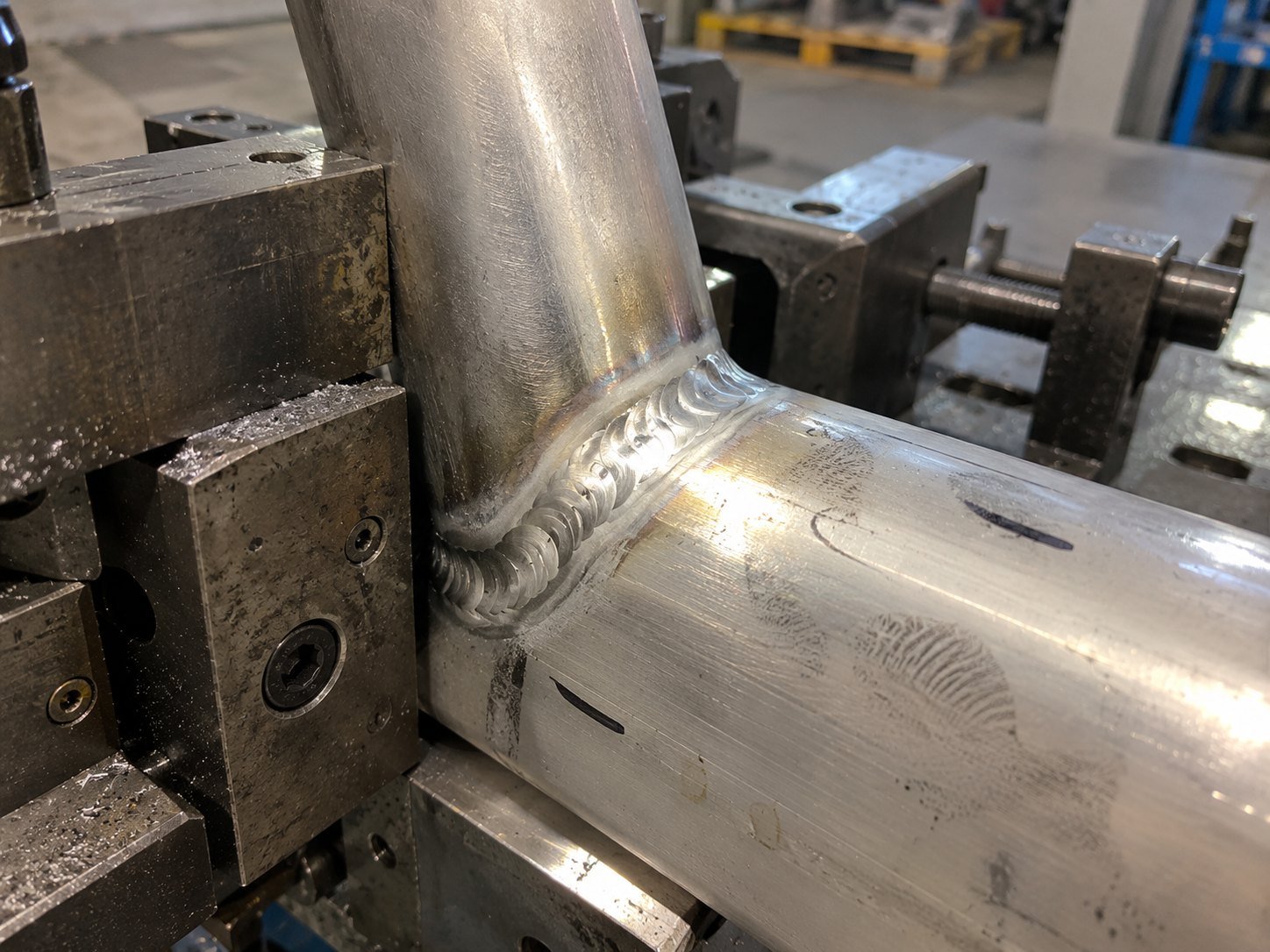
A laser welding work centre is joining our production in Kaunas, next to the existing ABB and Fronius CMT robotic welding cells. In practice this means we can select the right process for the product instead of fitting the product to the only available technology: sheet is cut on a 12 kW laser, tubes on the tube laser, and the assembly is welded and coated in the same plant.
FAQ
Can aluminium be laser welded?
Yes. Aluminium is more demanding because of reflectivity and thermal conductivity, so parameters are set per alloy and joint type. We assess suitability for a specific part from the drawing.
What is the maximum thickness?
It depends on the material and joint type. Laser welding is strongest in the thin range, up to a few millimetres; for heavier structures robotic MIG/MAG is usually more economical.
Do you need a fixture?
Often not, if the parts carry tab & slot locating features. More complex assemblies get a simple locating jig.
How is laser welding different from laser cutting?
Same fibre laser technology, different parameters and purpose: cutting removes material, welding fuses it. The two operations often sit in the same production flow.
Will the seam need grinding?
Usually not. Eliminating grinding and polishing is the main economic argument for laser welding on visible seams.
Related: Welding services · Laser cutting · Sheet metal fabrication · Request a quote