
Price per piece is the least informative number on a fabrication quotation. What decides whether the project runs on time is how many companies touch the part, who owns the tolerance when something is out of spec, and whether the quoted lead time ends at a cut blank or at a packed, coated, assembled product. Seven questions surface all of that before the first order.
1. Which operations are genuinely in-house?
Two kinds of supplier answer the same RFQ: one manufactures on its own equipment, the other wins the order and distributes it to partner shops. The second often quotes lower, but your lead time depends on a link you cannot audit or call. Ask operation by operation – laser cutting, press brake bending, welding, powder coating, assembly.
Each outsourced step costs twice. It adds transport and queue time, rarely under three to five working days per handover, because your parts wait while the partner finishes somebody else’s batch. And it creates a quality handover, where responsibility disappears: the coater blames the weld pretreatment, the welder blames the cut edge, and you are the only party interested in a resolution.
| Criterion | Own plant | Distributed / brokered |
|---|---|---|
| Lead time control | One production plan | Set by the slowest unseen partner |
| Defect responsibility | One corrective action | Split between shops |
| Design feedback | From the people running the job | Second-hand or absent |
| Repeatability batch to batch | Same machine, same programme | Partner may change |
2. Finished product, or only parts?
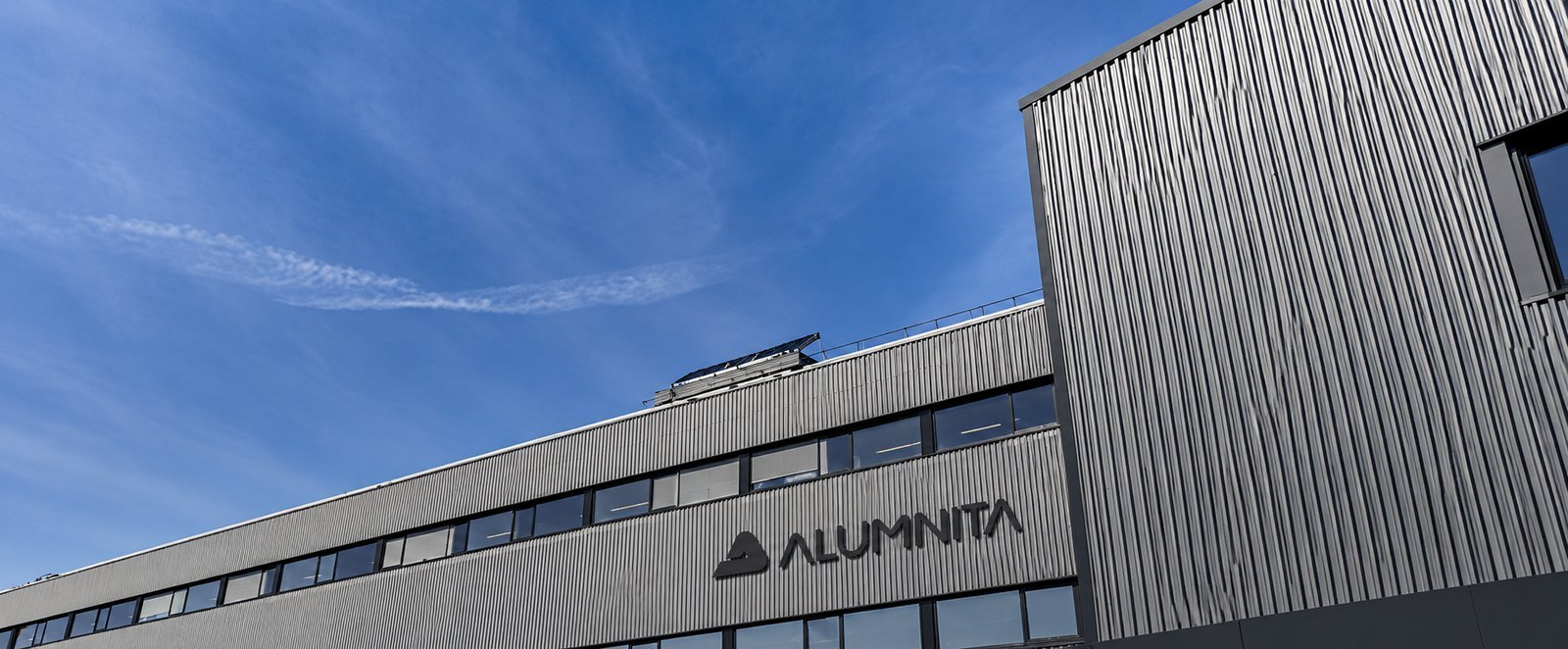
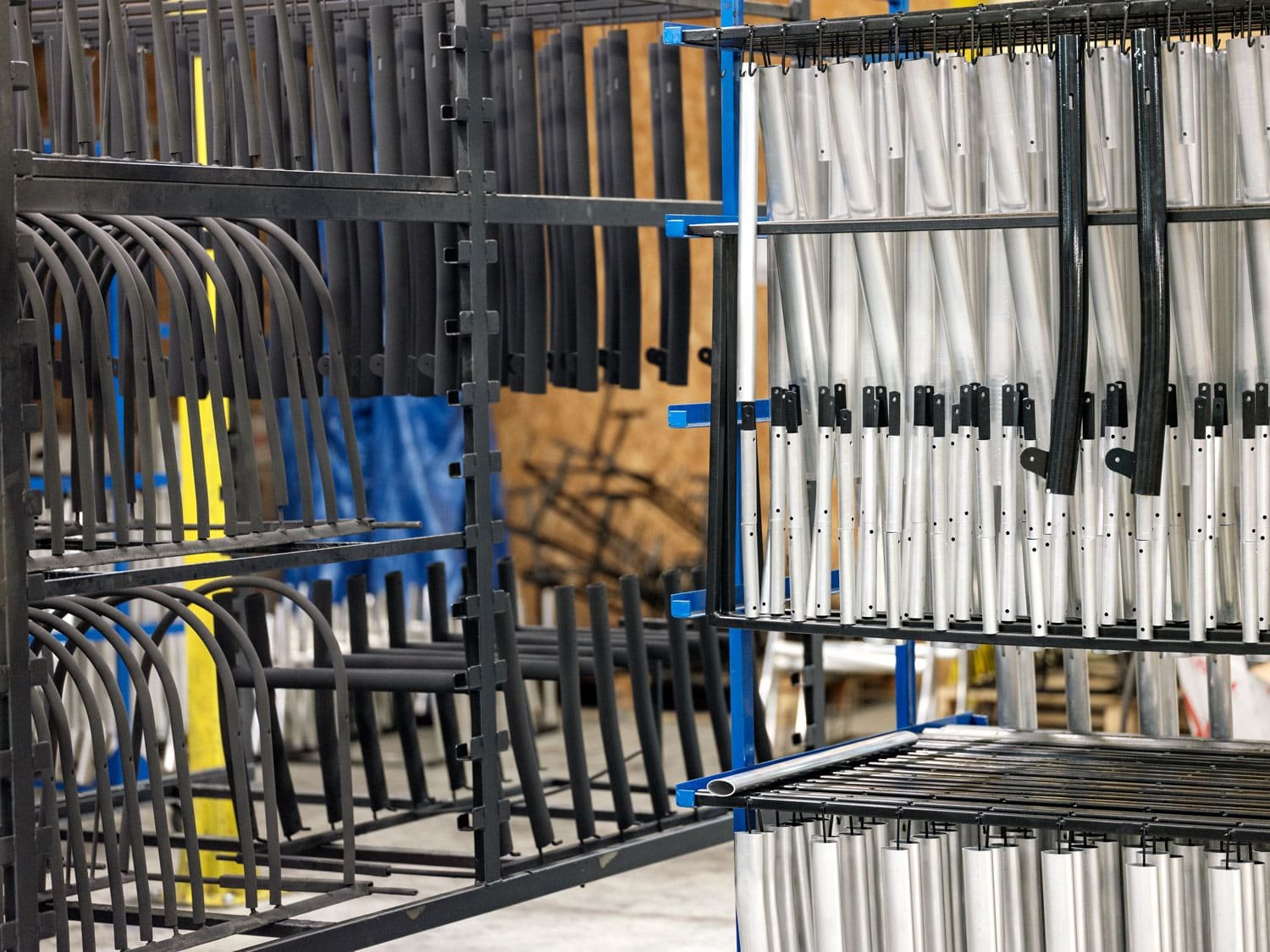
Buy cut and bent parts and you still own the welding fixture, the coating decision, the assembly labour and the argument when the colour is wrong. A single-source supplier takes the STEP file and delivers the item ready to fit. Ask whether the quotation covers a part or a finished assembly, and whether the lead time runs to the coated, assembled product – that one clarification prevents most lead-time disputes. At Alumnita sheet and tube laser cutting, bending, CNC milling, robotic welding, pretreatment, coating and assembly run in one plant in Kaunas: one contract, one date, one party answerable.
3. DFM feedback, and what makes a quote fast
A supplier who quotes a drawing without reading it is not doing you a favour. Useful quotations carry manufacturability notes: bend radii the alloy will not survive, flanges too short for the tooling, a seam the torch cannot reach, a hole too close to a bend line, no hanging point for the coating line. Each costs far more after series release. What makes quoting fast:
- STEP (AP214) – lets the supplier unfold, nest and estimate weld length without rebuilding the part.
- DXF for flat parts – closed contours, no duplicate lines, no construction layers.
- A PDF drawing – material grade, thickness, tolerances, RAL colour and gloss, weld symbols, threads.
- Quantity and call-off pattern – 200 a year in four releases prices differently from 200 once.
- Function, not only geometry – which face is visible, which is a fit, what load it carries. That is what lets engineering support propose a cheaper equivalent.
4. Is the prototype made on the series equipment?
A prototype welded on a bench and sprayed from a can tells you little about batch 500: different heat input, different distortion, different coating adhesion. Ask whether the prototype is cut, bent, welded and coated on the same machines as the future series, and whether a zero batch validates the fixture and robot programme before volume is released.
5. Documentation and traceability
Do not accept the word quality as an answer; ask which documents arrive with the goods, and agree it in the RFQ. A material certificate cannot be issued after the remnant has been scrapped.
- Material certificate EN 10204 3.1 – mill inspection certificate with actual values for your heat; specify it per order line.
- First article inspection – a measured report on the first part, approved by you before series release.
- Traceability – heat number linked to batch, so a material question in year three has an answer.
- Coating records – pretreatment, film thickness, adhesion, curing. For coastal work ask for Qualicoat Seaside class.
- Welding competence – who welds, to which qualification, and whether critical seams are defined on the drawing at all.
Ask where the supplier stands on ISO 9001. An honest answer beats a logo: at Alumnita ISO 9001 is being implemented, and we say so rather than imply a certificate we do not hold.
6. Capacity, logistics and packaging
The real question is not what the supplier can do this month but what happens when your volume doubles and a competitor orders the same week. Ask how many shifts the key work centres run and where the constraint actually sits – usually not the laser but welding, coating throughput or assembly labour.
From Kaunas a dedicated load typically runs two to four days in transit to Germany, Poland and the Benelux, three to five to Scandinavia; groupage adds consolidation time. What matters is that the agreed lead time says ex works or delivered, in writing. Packaging deserves its own RFQ line: coated parts scratch against each other, so fix interleaving, edge protection, stacking height and pallet type before the first shipment.
7. Commercial terms, tooling and language
- Tooling and fixtures – who pays, who owns, can you take them elsewhere? This is where lock-in is created quietly.
- Price validity – aluminium and stainless move; agree 30, 60 or 90 days and how alloy surcharges pass through.
- Payment terms – prepayment on a first order is normal; refusing to discuss terms after three clean deliveries is not.
- Language and time zone – who is your contact, in which language, and is that person technical? Lithuania is one hour ahead of CET, so a morning question gets a same-day answer.
- Revisions and IP – how revision changes are confirmed, and what the supplier may show as a reference.
When a local supplier is the better answer
Do not import everything. A shop 30 km away wins when you need five parts tomorrow for a line stoppage, when the part is large, light and freight eats the difference, when the design still changes weekly, or when annual spend is too small for either side to invest. Cross-border contract manufacturing pays off on repeating series, on multi-process assemblies where single sourcing removes handovers, and where aluminium or stainless work plus coating is a real cost block – not on emergency one-offs.
The seven questions for your RFQ
- Which operations run in your own plant and which are bought in? Answer per operation.
- Can you deliver the finished, coated, assembled product, and does your lead time run to that point?
- Will you review the drawing for manufacturability and send notes with the quotation? Which files do you need?
- Will the prototype run on the series equipment, and do you produce a zero batch before volume release?
- Which documents come with delivery – EN 10204 3.1, first article inspection, coating thickness, traceability from heat number to batch?
- What is your capacity on the bottleneck operation, and your answer if our volume doubles within a year?
- Who owns tooling we pay for, how long are prices valid, how is packaging specified, and who is our technical contact?
Answers in writing without hedging make the price comparison meaningful. Vague answers mean the cheap quotation is cheap because the risk stays with you. Send the drawing and the questions together – request a quote and judge the answers, not only the number.
FAQ
What exactly is a metal fabrication subcontractor?
A manufacturer that produces to the customer’s drawings on its own equipment instead of selling its own products. You own the design; the subcontractor owns the process, the tolerances and the delivery.
Can I order a single part or a prototype?
Yes – prototypes and one-offs are produced from one piece, including powder coating in any RAL colour. The point is to run that piece through the same process chain as the future series.
Which files should I send with an RFQ?
STEP for 3D geometry, DXF for flat parts, and a PDF drawing with material grade, thickness, tolerances, welds and RAL colour. Add annual quantity and call-off pattern – both change the price.
Is an EN 10204 3.1 certificate always available?
It is available when specified with the order, because the material has to be bought and traced against that requirement from the start. Requesting it after production is often impossible.
Related: Contract manufacturing · Sheet metal fabrication · Equipment · Request a quote