
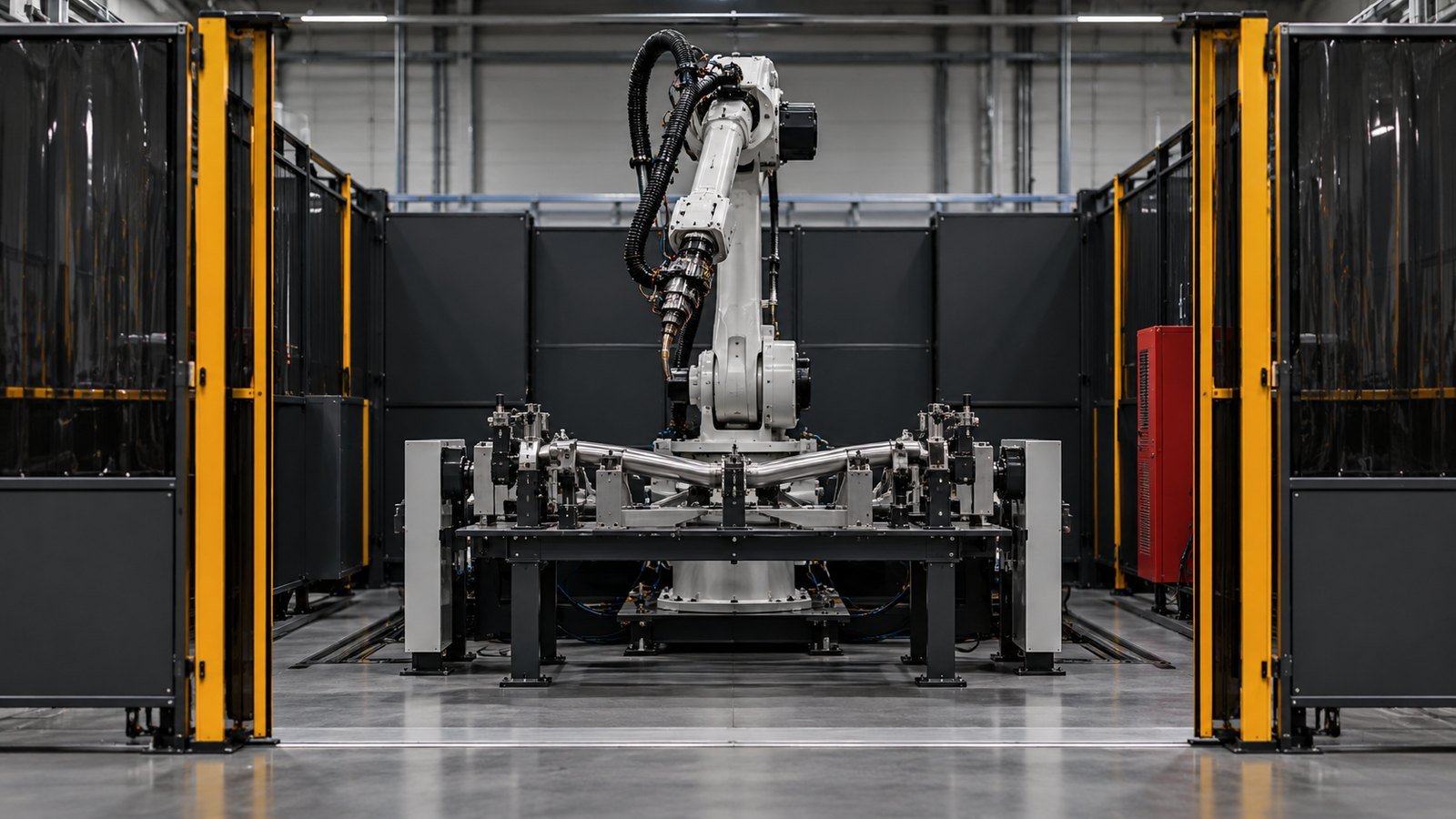
Three new work centres are joining Alumnita’s plant in Kaunas: sheet laser cutting, tube laser cutting and laser welding. Together with the ABB robotic welding cells and the in-house powder coating line they close the production cycle – we cut, weld and coat under one roof, with no subcontracting in the middle. For a buyer that is not a machine list; it is fewer handovers, shorter lead times and one party answerable for the finished part.
What a closed cycle actually means for your order
Until a plant owns every step, each operation it buys in adds transport, queue time and a quality interface. The parts wait while a partner shop finishes somebody else’s batch, and when a coated weld seam looks wrong, two companies have an argument and the customer has a delay. With cutting, bending, machining, welding, pretreatment, powder coating and assembly in one building, the part moves between work centres instead of between invoices.
| Work centre | Capability | Typical parts |
|---|---|---|
| Sheet laser | 12 kW fibre, 4000 × 2000 mm, ±0,02 mm, up to 80 m/min | Brackets, panels, covers, machine frames in sheet |
| Tube laser | 3 kW fibre, bevel cuts, remnant-free cutting, oval tube compensation | Welded frames, handles, trolleys, furniture structures |
| Laser welding | Thin sheet and visible seams | Enclosures, stainless fronts, design-critical joints |
Sheet laser cutting: 12 kW, and why the power rating matters less than you think
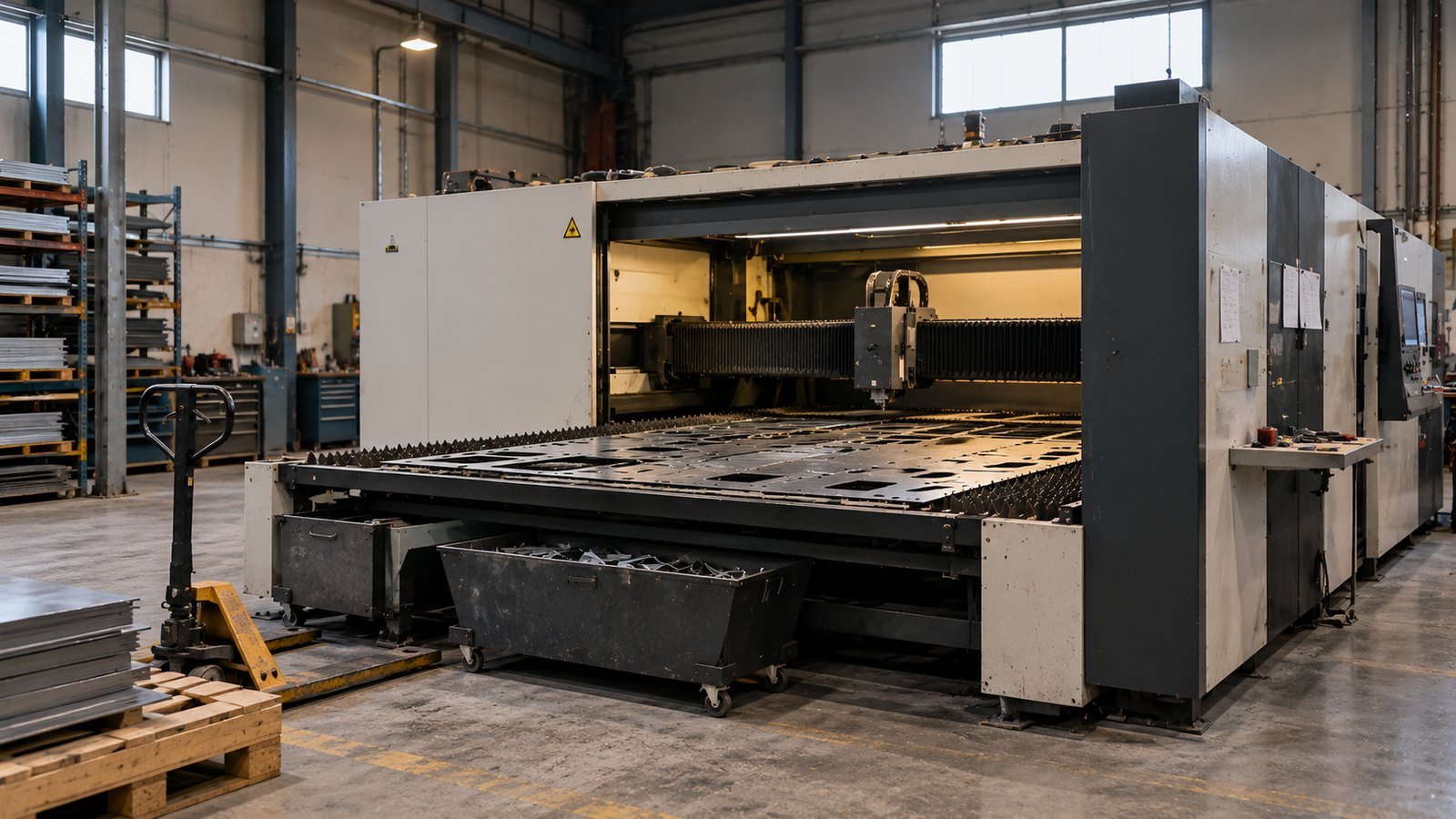
A 12 kW fibre source cuts a 4000 × 2000 mm sheet at a positioning accuracy of ±0,02 mm and travels at up to 80 m/min on thin material. The headline figure buyers fixate on is thickness capacity, but on most real jobs the money is in the speed on 1–4 mm sheet, where the laser spends most of its time, and in cut edge quality, which decides whether a part needs deburring before welding and coating.
What changes in practice: parts that previously left the building for cutting now stay. Nesting is planned against our own schedule rather than a partner’s, so a revision on Tuesday does not cost a week. And because laser cutting sits next to press brake bending, the bend allowance used in the flat pattern is the one our own brake will actually produce – the most common source of parts that measure right on the drawing and wrong on the fixture.
Tube laser cutting: frames that assemble themselves
A tube laser is not simply a faster saw. It cuts the profile to length and, in the same clamping, puts in the holes, slots, cable openings, bevels and tab & slot features. Three things in the specification matter commercially:
- Bevel cutting – weld preparation is cut in, not ground in afterwards. On a frame with 40 joints that is hours of grinding removed per unit.
- Remnant-free cutting – the programme uses the full stock length, so material cost per frame drops instead of ending up in the offcut bin.
- Oval tube compensation – real tube is never perfectly round or perfectly straight; compensation keeps hole positions true on oval and twisted stock, which is exactly where sawn-and-drilled frames go out of tolerance.
The practical effect is on the welding bench. Tab & slot joints locate the parts themselves, so a frame that used to need a dedicated welding fixture can often be built on a simple stop plate. That removes fixture cost from the first order – the single biggest barrier when a customer wants 10 frames before committing to 300.
Laser welding: thin sheet, visible seams, less rework
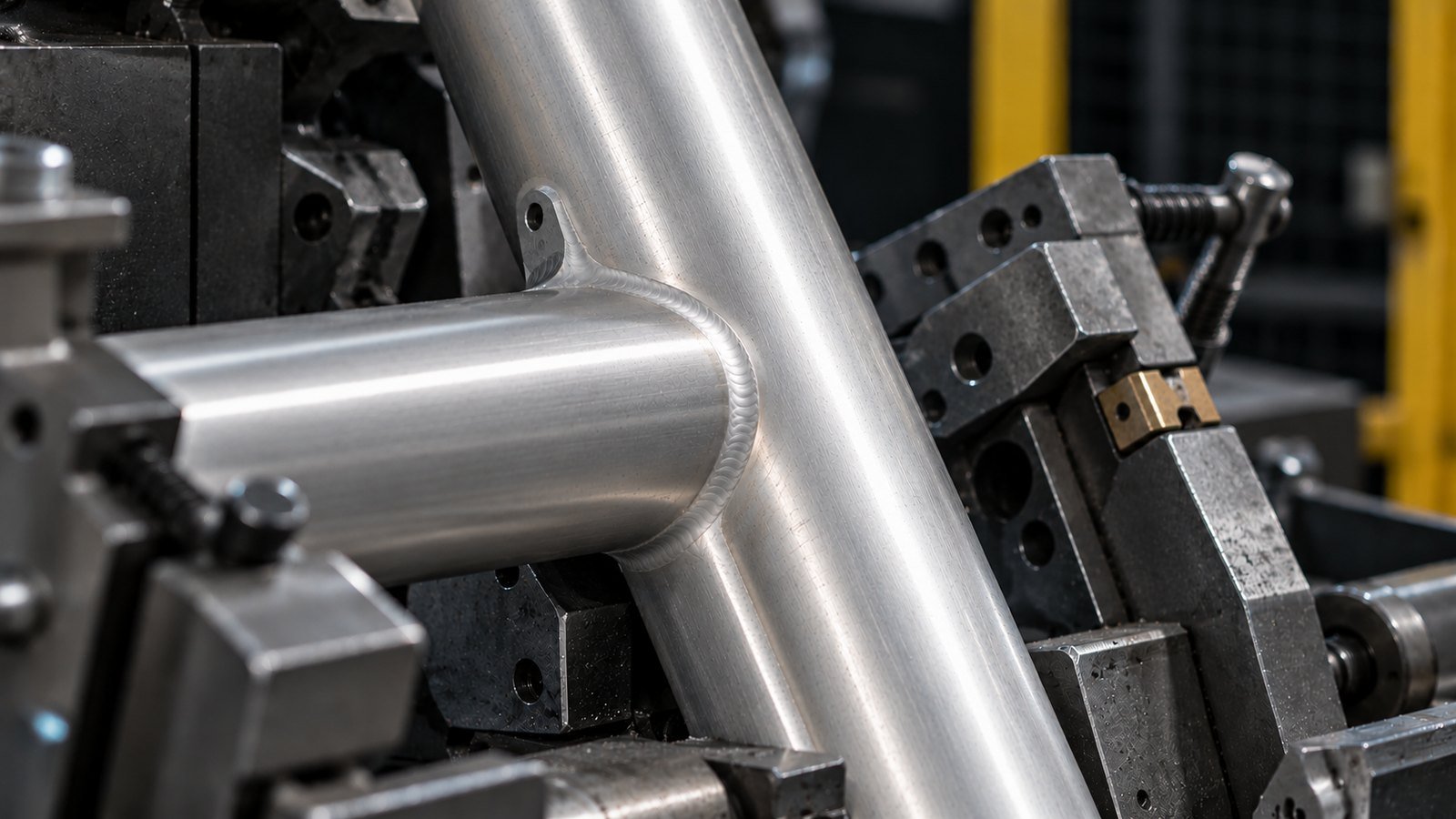
Laser welding puts a narrow, low-energy seam into the joint. The heat-affected zone is small, so thin material distorts far less – the 1–2 mm stainless and aluminium parts that warp under conventional welding and then need straightening. On visible seams it changes the finishing economics: a narrow, regular seam needs little or no grinding and polishing, and grinding hours on a visible stainless front are often a larger cost than the welding itself.
It complements rather than replaces the ABB robot cells with Fronius CMT, which remain the right answer for thicker sections, long structural seams and gap-tolerant joints on real-world fit-up. We choose per joint, not per machine.
What gets faster, what gets cheaper, what becomes possible
- Faster – lead time, because cutting is no longer handed to a partner and queued behind another customer. Revisions and repeat call-offs feel the difference most.
- Cheaper – tube frames, through remnant-free nesting, cut-in bevels and tab & slot location that removes fixture work; and thin welded products, through less straightening and grinding.
- Newly possible – one-piece sourcing of mixed sheet-and-tube series, where the frame, the sheet panels, the welding and the coating all come from one supplier against one drawing set.
- Unchanged – the quoting discipline. Send STEP plus a PDF drawing with material grade, tolerances and RAL colour, and the quote comes back faster and firmer.
The parts that benefit most
Agricultural machinery brackets and guards, where cut edge quality and coating adhesion decide field life. Street, park and outdoor furniture, where tube frames meet sheet panels and the visible seam is the product. Trolleys and handling equipment, where tab & slot frames cut both fixture and assembly time. Fencing and architectural metalwork in aluminium – EN AW-5754 sheet and structural EN AW-6082 T6 – and in stainless 1.4301 and 1.4404. For coastal and marine installations the coating line can deliver Qualicoat Seaside class.
When a laser is the wrong answer
Honestly: not every part should be laser cut. Above a few thousand identical simple parts a year, stamping tooling beats laser time on cost per part, and the tooling investment pays back. Thick plate with loose tolerances is often cheaper plasma cut. Prismatic parts with tight bores and flatness belong on CNC milling, not in sheet. And laser welding needs tight, repeatable fit-up: on a hand-tacked assembly with a 1 mm gap, the gap-tolerant robot process is the better – and cheaper – tool. A supplier who tells you which process not to buy is the one worth quoting against.
FAQ
Can I order only laser cutting, without the other operations?
Yes. Single operations and complete products are both available – cut blanks, cut and bent parts, welded assemblies or the finished coated product.
What is the largest sheet you can cut?
The sheet laser works a 4000 × 2000 mm format at a positioning accuracy of ±0,02 mm. Larger products are built as welded assemblies from parts within that format.
Why does a tube laser reduce the cost of a welded frame?
Because holes, cut-outs, weld bevels and tab & slot locating features are produced in one clamping. The frame self-locates on the bench, so less fixture work and less grinding are needed.
Does laser welding replace robotic welding?
No. Laser welding suits thin material and visible seams; the ABB robot cells with Fronius CMT remain better for thicker sections, long structural seams and joints with real-world gaps.
How do I get a price for a part across several of these processes?
Send a STEP file plus a PDF drawing with material grade, thickness, tolerances and RAL colour, and state the annual quantity and call-off pattern. Request a quote and the whole chain is priced as one lead time.
Related: Laser cutting · Tube laser cutting · Equipment · Industries