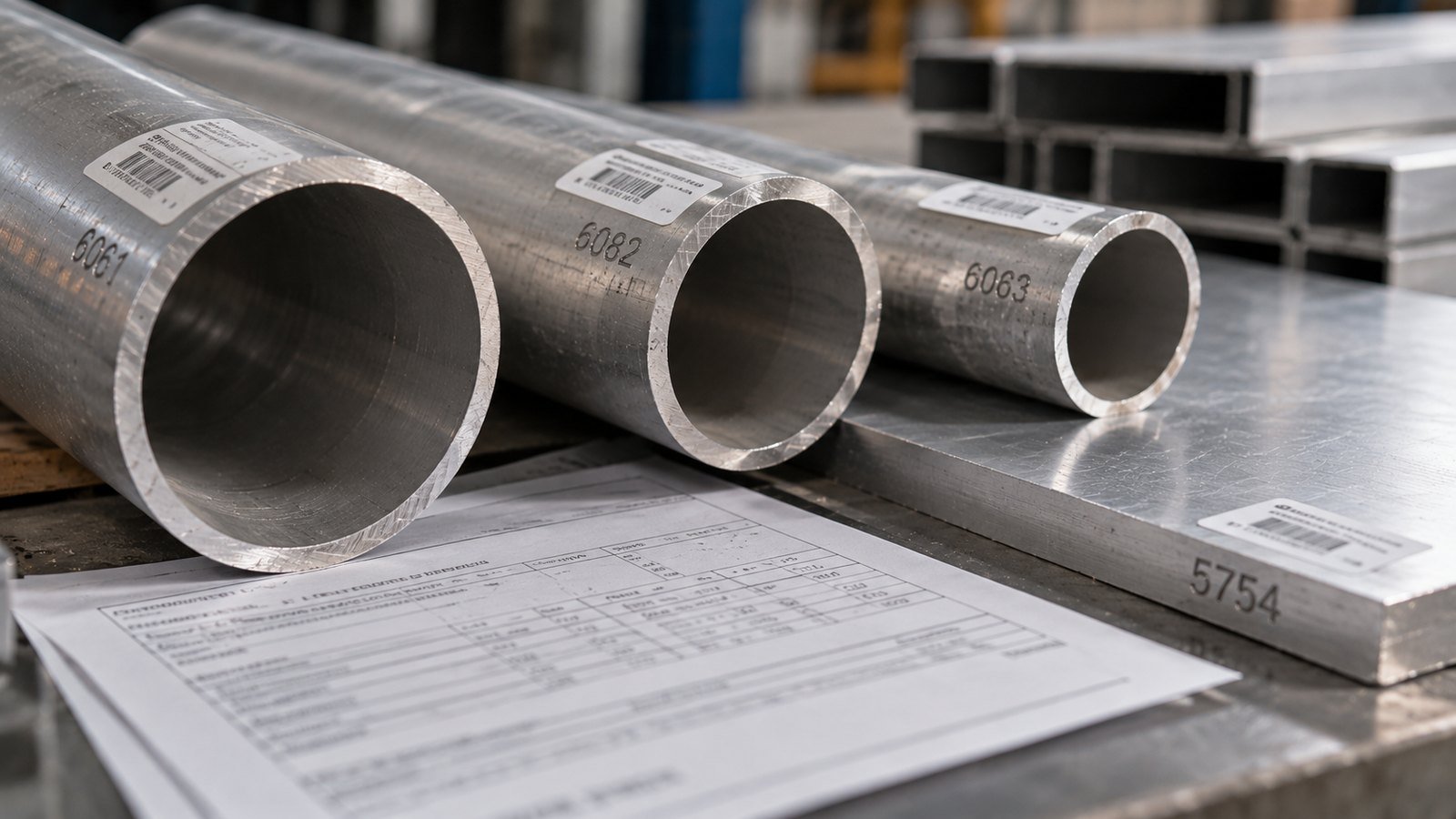
Choose EN AW-5754 when the part is bent or welded; choose EN AW-6082 T6 when the part has to carry load. The two alloys get their strength in completely different ways – 5xxx from magnesium plus cold work, 6xxx from precipitation hardening in a furnace. Every practical difference in bending, welding and machining follows from that one fact, and so does most of the cost.
Two different strengthening mechanisms
EN AW-5754 (AlMg3) is non-heat-treatable. It comes as sheet in H111 or H22 temper, typically Rp0,2 of 80–130 MPa with elongation A50 of 18–20 %. That elongation is exactly what makes it forgiving on the press brake and tolerant of a tight inside radius.
EN AW-6082 T6 (AlSiMgMn) is heat-treatable. Solution treatment plus artificial ageing lifts Rp0,2 to roughly 250–260 MPa, but elongation drops to 8–10 %. You buy strength and pay in formability and weldability. Hardness runs about 95 HB against 55 HB for 5754, which is why 6082 gives a far cleaner finish in CNC milling while 5754 tends to smear and build a burr.
Side-by-side comparison
| Property | EN AW-5754 | EN AW-6082 T6 |
|---|---|---|
| Family | Al–Mg, non-heat-treatable | Al–Mg–Si, precipitation hardened |
| Yield strength Rp0,2 | ~80–130 MPa | ~250–260 MPa |
| Elongation | 18–20 % | 8–10 % |
| Min. inside bend radius | ~0,5–1,0 × thickness | ~2,5–3,0 × thickness |
| Weldability | Good, no hot-cracking tendency | Hot-crack sensitive, loses T6 in the HAZ |
| Corrosion resistance | Very good, marine and de-icing salt | Good, needs coating in salt spray |
| Anodising | Acceptable, slightly duller tone | Very good, clean even tone |
| Usual supply form | Sheet 1–6 mm | Extrusion, bar, plate, thick sheet |
When to specify EN AW-5754
- Multi-bend sheet parts. Enclosures, trays, covers and brackets with three or more bends, where a tight radius matters more than yield strength.
- Welded fabrications. Housings, tanks and frames joined by MIG or robotic welding. The as-welded joint keeps most of the parent strength, because there was no T6 condition to lose.
- Wet or salt-laden service. With magnesium below 3,1 % it is not prone to the sensitisation that limits higher-Mg grades, so it is safe for coastal and transport work.
When to specify EN AW-6082 T6
- Load-bearing structure. Frames, mounting brackets, axles, machine bases, lifting points – anywhere a stress calculation drives the thickness.
- Machined parts. Bearing seats, bores, mating faces and threads. The harder matrix holds a tolerance and gives a better surface.
- Strength-to-weight critical designs. At equal stiffness, 6082 T6 lets you drop a millimetre or two of wall compared with 5754.
Bend radius and hole placement
The usual failure on 6082 T6 is orange-peel followed by a crack on the outside of the bend. Keep the inside radius at 2,5–3 × thickness and bend across the rolling direction, not along it. If the drawing genuinely needs both a sharp bend and T6 strength, there are two honest options: form the part in T4 and age it afterwards, or move to 5754 and add thickness. 5754 takes 0,5–1,0 × t without complaint on standard press brake bending.
The second rule applies to both alloys: the distance from the edge of a hole to the start of the bend radius should be at least 2,5 × thickness plus the bend radius. Closer than that, the hole stretches into an oval as material flows. The same figure drives the bend relief notch at the end of a flange – without it, the corner tears.
Welding: what actually happens to T6
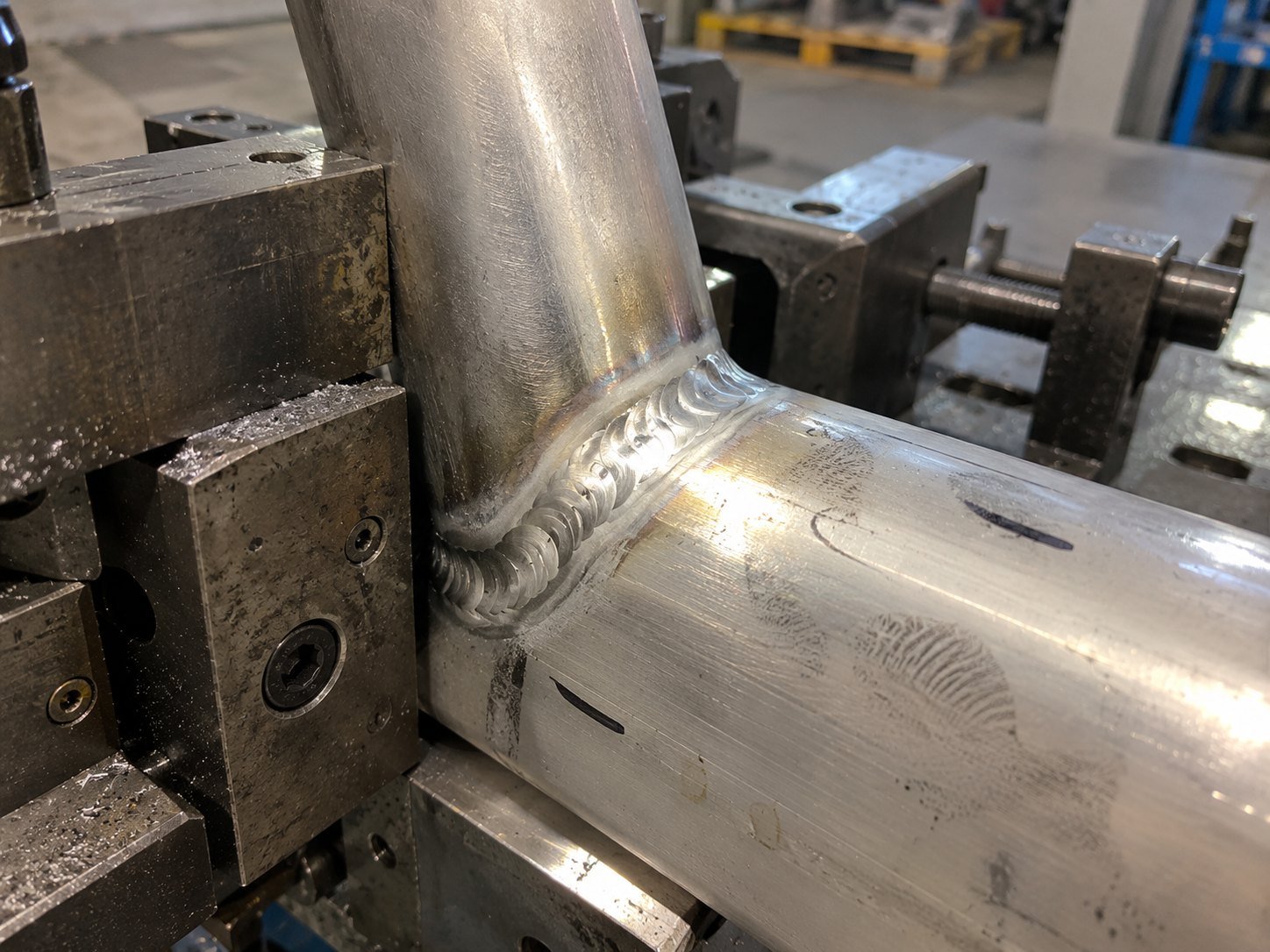
T6 is a furnace condition, and an arc destroys it locally. In the heat-affected zone of a MIG weld, 6082 T6 drops to roughly half its parent yield strength – EN 1999-1-1 applies a HAZ softening factor of about 0,48 for exactly this case. If your calculation uses 250 MPa and the load path runs through a weld, the calculation is wrong.
Filler choice is not optional either, because 6xxx is sensitive to solidification cracking. ER 4043 (AlSi5) gives better crack resistance and is the default for structural 6082; ER 5356 (AlMg5) gives higher joint strength and a much better colour match if the part will be anodised. For 5754, 5356 is the standard filler. The practical conclusion: on a heavily welded assembly, 5754 – or 5083 in thick structural sections – is often the better answer even at lower starting strength, because it keeps what it starts with.
Finishing: anodising or powder coating
6082 anodises to a cleaner, more even tone; 5754 can come out slightly grey, and seams welded with 4043 filler anodise noticeably darker than the parent metal. For most industrial parts powder coating removes the question entirely. Where the alloy still matters is coastal installation, and there we apply Qualicoat Seaside class pre-treatment and coating – which in turn imposes its own design rules: drain and hanging holes, and no closed pockets that trap pre-treatment chemicals.
What to put on the drawing
State the alloy and the temper together. Not "aluminium", not "AlMg3", but EN AW-5754 H111 or EN AW-6082 T6. A drawing that says only "aluminium" stops the quote, because the alloy decides the achievable bend radius, the filler wire, the tolerance, the finishing route and the price of the blank.
Also mark which dimensions are functional: a blanket ±0,05 mm on a sheet part pushes the whole thing into machining, when a general class to EN ISO 2768 would serve the rest. If you are unsure, send the drawing with the function and load case – we will come back with an alloy recommendation and achievable radii, for a prototype or for series production. Process limits behind these numbers are described under aluminium and laser cutting.
FAQ
Which alloy bends better?
EN AW-5754, by a wide margin: about 0,5–1,0 × thickness inside radius, against 2,5–3 × thickness for 6082 T6, which can crack on a sharp bend.
Can EN AW-6082 T6 be welded?
Yes, but the heat-affected zone loses roughly half its yield strength and the alloy is hot-crack sensitive. Use ER 4043 for crack resistance or ER 5356 for strength and colour match.
Which one suits marine and coastal use?
The 5xxx family – 5754 in sheet, 5083 in thicker structural sections. For coated parts in coastal exposure we offer Qualicoat Seaside class powder coating.
Is 6082 T6 more expensive than 5754?
Per kilogram the difference is modest, but total part cost diverges: 6082 needs larger radii, more careful welding and sometimes a thicker blank, while 5754 costs more to machine.
What if I do not know which to choose?
Send the drawing with the function and load case via request a quote. We will propose the alloy based on whether the part is bent, welded or load-bearing.
Related: Sheet metal fabrication · Welding · Contract manufacturing · Request a quote